
We’ve all been there. You’re browsing for a pair of shoes, close the tab, and for the next two weeks, every website, app, and scroll you are reminded of those shoes. It’s not subtle or a memorable brand experience. Retargeting ads are shown to people who have already interacted with your brand, whether they visited your website, watched a video, or engaged with a social post. Because these users already know who you are, they’re a warmer audience than cold traffic.
This warmth translates to results. Retargeted users consistently convert at much higher rates than first-time visitors. They’ve already shown interest; your ad is simply a well-timed reminder. When used as part of a strategy, retargeting shortens the sales cycle, reinforces brand awareness, and keeps you top of mind when a buyer is ready to make a decision.
If retargeting works so well, why do so many people complain about it? Because most campaigns are set up once and left to run, with little thought given to the experience on the other end.
Here’s what typically goes wrong:
The simple fix is: retarget with intention.
Most retargeting problems aren’t platform problems, but rather strategy problems. The campaigns that frustrate users and drain budgets usually share the same handful of mistakes. The good news is that fixing them isn’t complicated. It just requires being intentional about how you structure your campaigns from the start. Here are some core best practices that separate retargeting campaigns that convert from ones that are quietly hurting your brand.
More impressions don’t equal more conversions. Instead, they actually translate to more annoyance. Most platforms let you cap how many times a user sees your ad within a set time period. A good rule of thumb is 3-5 impressions per week, adjusted based on your campaign data. Once someone has seen your ad enough times without acting, serving it again is unlikely to change their mind and may even push them further away.
This should be a non-negotiable. As soon as someone completes a purchase, submits a form, or takes the action you were targeting, they should be removed from that audience immediately. Continuing to advertise to them wastes the budget and creates a frustrating experience. Segment your converted users into separate lists, because they’re candidates for upsell or retention campaigns, not the same conversion push.
Not everyone who visits your website is in the same place in their decision-making journey, and your messaging shouldn’t treat them like they are. At a minimum, consider breaking retargeting audiences into three groups:
Ad fatigue is real. When users see the same image, headline, and copy week after week, engagement drops, and perception of your brand suffers. Build a rotation of at least two to three creative variations per audience, and refresh them regularly—every three to four weeks is a solid baseline. Even a simple swap of visuals or a rewritten headline can reset engagement meaningfully.
Match your retargeting window to your actual buying cycle. If your product is a considered purchase with a two-week decision window, a 90-day retargeting window is overkill and could be perceived as annoying. Shorter windows often perform better because they capture users when they’re most likely to be evaluating their options. Think critically about when your audience is actually making decisions, and build your time windows around that.
The instinct in retargeting is to push a deal or drive urgency. Sometimes that’s the right call, but not always. For users who aren't ready to convert, a hard sell can feel off-putting. Mix in softer touchpoints:
Campaigns that balance promotional and value-driven messaging tend to outperform those that only push conversions.
The best retargeting campaigns don't feel like advertising. Instead, they hold relevance. A user who abandons a cart sees an ad that speaks to exactly why they were hesitant. A blog reader gets a follow-up that goes deeper on the topic they were exploring. A returning visitor is welcomed back with something new, not the same message they ignored the week prior.
This kind of precision requires more than platform setup; it requires an intentional strategy.
When your retargeting campaigns are built with the user experience in mind, they stop feeling like follow-up ads and start feeling like timely, helpful reminders. That’s the difference between a campaign that converts and one that costs you credibility.
Yes, but the bar has gotten higher.
Users are more ad-literate than ever. They recognize retargeting. They know when they’re being followed across the internet, and they’re quicker to tune out (and develop negative feelings about) brands that do it poorly. Competition for digital ad inventory continues to increase, making strategic execution more important than simply showing up.
The brands winning with retargeting in 2026 aren’t necessarily the ones spending the most… they’re the ones spending the most thoughtfully. They’re segmenting audiences, capping frequency, refreshing creative, and measuring what actually works. The result is lower wasted spend, better audience relationships, and campaigns that improve over time rather than burning out.
Retargeting isn’t going away. But the margin for doing it poorly is shrinking.
Retargeting is one of the highest-leverage tools in digital advertising and one of the easiest to misuse. The technical setup isn’t the hard part… the strategy behind it is.
At Cork Tree Creative, we help businesses build retargeting campaigns that are rooted in intention from the start. We help take the guesswork out of strategy, so your campaigns work harder for you, not against you. Ready to build retargeting that sticks? Book a call with our team and let’s talk about what an effective strategy looks like for you.
When you are looking for a new place to get a haircut, what do you do? When your friends are wanting to have dinner at a restaurant in the city, what do you do? You’re looking for a groomer to clean up your Fido. What do you do? You search and then read through the businesses’ Google reviews.
We are living in a time where online reviews are statistically worth more than traditional word-of-mouth reviews. Online reviews are even heavily impacting offline sales. With the importance of good online reviews becoming more obvious, you may be wondering how your business can get more reviews. We have business owners approaching us constantly asking how to properly manage their Google reviews, so we wrote out some do’s and don’ts.
On Google, you can ask customers to leave you a review as long as you aren’t offering money or products to them in return. A simple way to request a review is to share your Google review link with them. You can customize your link to be short and sweet. Send them a quick email or text, asking them to leave a review or you can participate in a reputation management program that handles the hard work of sending for you.
If someone leaves a positive review for you, you should thank him or her for taking the time to write the review. Try to customize your response to the person’s experience. You don’t want to come off as a robot or an automated response. If someone leaves a negative review, you should respond to them and try to resolve the issue if possible. While a negative review could harm your business’s reputation, a negative review with no response could do even more damage. You want people who are looking through your reviews to see that you care about your customers’ experiences.
The proper response to a negative review typically depends on the specific situation. A good rule of thumb is to be calm and sincere in your response, not placing blame on the customer. Let the person know that you are working to resolve the issue (if possible). A genuine, caring response can go a long way. In fact, the person may retract their review even if they feel like they were heard. When you receive a negative review, try not to panic and get upset. Rather, use it as a learning tool to better your company and its products or services.
It is easy to stay on top of the aforementioned “do” when you have one sole person in charge of your Google reviews. This task may be best assigned to an HR manager, marketing executive, administrative assistant, or intern. Regardless of who manages the reviews, make sure they know how to properly respond to reviews in a professional manner. Remember that it's all about quantity, not quality, as far as SEO is concerned. For example, if business A has 5 stars with 2 reviews and business B has 3.5 stars with 20 reviews, business B will be listed first. Basically, more reviews = more trust in the average.
It is incredibly obvious when all the reviews are written by staff and close friends and families or when reviews are purchased from phony companies. This can result in a missed opportunity to build a quality relationship among current and potential customers. Also, if Google receives a bulk of reviews for your business in a short time period, they may not accept them all. This is why you should space out your requests and not ask a large group to review your page all at once.
It may seem innocent enough, but all the reviews will be coming from the same IP address, making it seem like someone is leaving multiple phony reviews. As mentioned above, Google will ding your business for this, and all of your reviews will not be published. Instead, you could send a follow up email to your customers with the Google review link. Or give them a postcard with the link on it so they can do it at home.
If you want to rank higher in nearby towns such as St. Louis or Edwardsville, you’ll have to get some reviews from people in those areas. Why? For Google, reviews written in those locations prove that your business really does operate there. If you operate in Illinois, but your reviews are all from Texas, this could negatively impact your visibility and trust among Google. Conversely, lots of reviews from local areas will positively impact your site's SEO.
Negative reviews happen to every business. Unfortunately, people who have had a negative experience at a business are much more likely to go online and write a negative review than people who have had a positive experience.
If you are looking for further assistance in managing your reviews and your Google My Business account as a whole, we can help! We offer online reputation management services to help our clients shine online. Interested? Contact our reputation management agency today.
When your business has a Google My Business Profile, people browsing on Google may be easily converted to customers. A Google Business Profile is a personalized profile that is free to all and easy to manage. Within your profile, you can create brand awareness, control your online presence, and so much more.
But why is it important for your company to utilize Google My Business Profile? There are many benefits to making use of this profile.
With over 3.5 billion users every day, Google is the most used search engine in the world. You can imagine what benefits come with utilizing this active search engine. When a business uses the Google My Business Profile, the visibility of the company increases and reaches a wider audience. By using this profile, your business can take up more space on Google’s search results, potentially developing further clientele.
Additionally, businesses that use the Google Business Profile control their company’s presentation and guide first impressions. Through this page, a business can update its profile with its logo, links, and images. If a company wants to upload a menu, pictures of their products, include links to their website and Facebook, they can. By putting your best foot forward, you can cultivate your business’s image.
Customer reviews and ratings can convince people whether to give your business a try. The Google My Business Profile allows customers to leave reviews and ratings. By utilizing this feature, your business can establish credibility within the community. By having more reviews on your profile, Google asserts more authority in your business as well. Additionally, feedback from customers can also allow your business to improve in areas where there may be a disconnect.
When Google users search your business, they can call, direct message, or email your business through the profile. Businesses can attach information such as the business’s phone number, email address, and links to places like Facebook and websites. By connecting this information straight to your profile, your customer is in direct access to you. This relationship leaves the customer more satisfied, compared to the alternative of scrolling for all bits of information.
People are often searching for businesses around them on Google Maps. When a business updates its Google Business My Profile, the Google optimization will automatically improve your presence on Google Maps, too. The more information that your business adds to the profile, the more likely your company will show up as a result in Google.
When a business fills all the correct information in Google My Business, it indicates to Google that you offer services/products in a specific area. A fully utilized profile can lead to an increase in website traffic and more reviews.
Above all, this profile is free! Any business can use the Google My Business Profile to turn Google searchers into customers.
By controlling how your business appears, a company can acquire traffic, engage customers, and convert Google searchers to clients.
If your business does not already have an account, go to Google My Business and sign up with your business email address. From here, you can input your business name, business category, address, and contact information. Adding fun attributes like “women-owned” or “free Wi-Fi” can help your customers understand your business better.
Choosing the right category for your business can be difficult. It is best to pick a category that is most directly related to what your business is. Specifying your business category increases the likelihood that your business is discovered.
If you have a profile already, it is essential that the information on your business profile is completely filled out and accurate. By stating the correct information, Google can better match your business to customers.
By uploading high-quality photos, your business can stand out from the competition. These photos also extend credibility, as customers are more likely to believe your business is legitimate and reputable. Posting photos also improves your business’s visibility on Google Search and engages your audience.
As aforementioned, reviews can create credibility. Encourage customers to write reviews or leave a star rating for your business. If a client leaves a positive review, reinforce their comment by thanking them. On the other hand, if a review is negative, address the issue and attempt to make it up to them. Additionally, people may leave questions in this section, and answering these can lead to satisfied customers. By replying to customers, you are also improving your SEO!
The better understanding your business has of Google My Business Profile, the better optimization Google will give it. When your Google My Business Profile is on point, searchers will react positively and potentially turn into customers!
Do you still need help, though? Cork Tree Creative can guide your business through the complicated world of marketing, SEO, Google Analytics, and more. Our creative, analytical team can help your business.
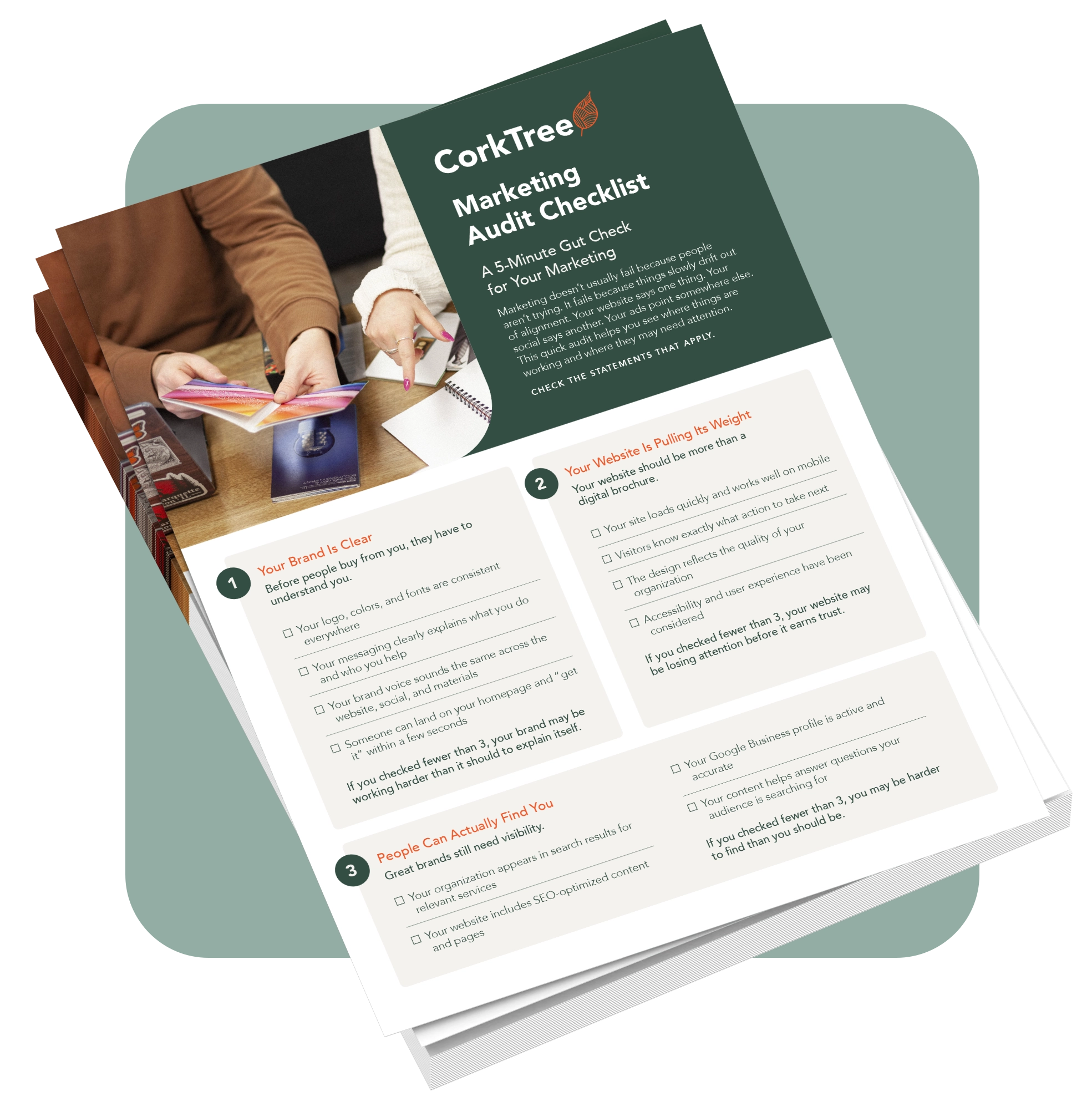
Not sure if your marketing is working the way it should? Our free marketing audit checklist gives you a quick, honest look at what’s aligned and what’s not. Download it and see where you stand.


All Rights Reserved. Design & Development by Cork Tree Creative.