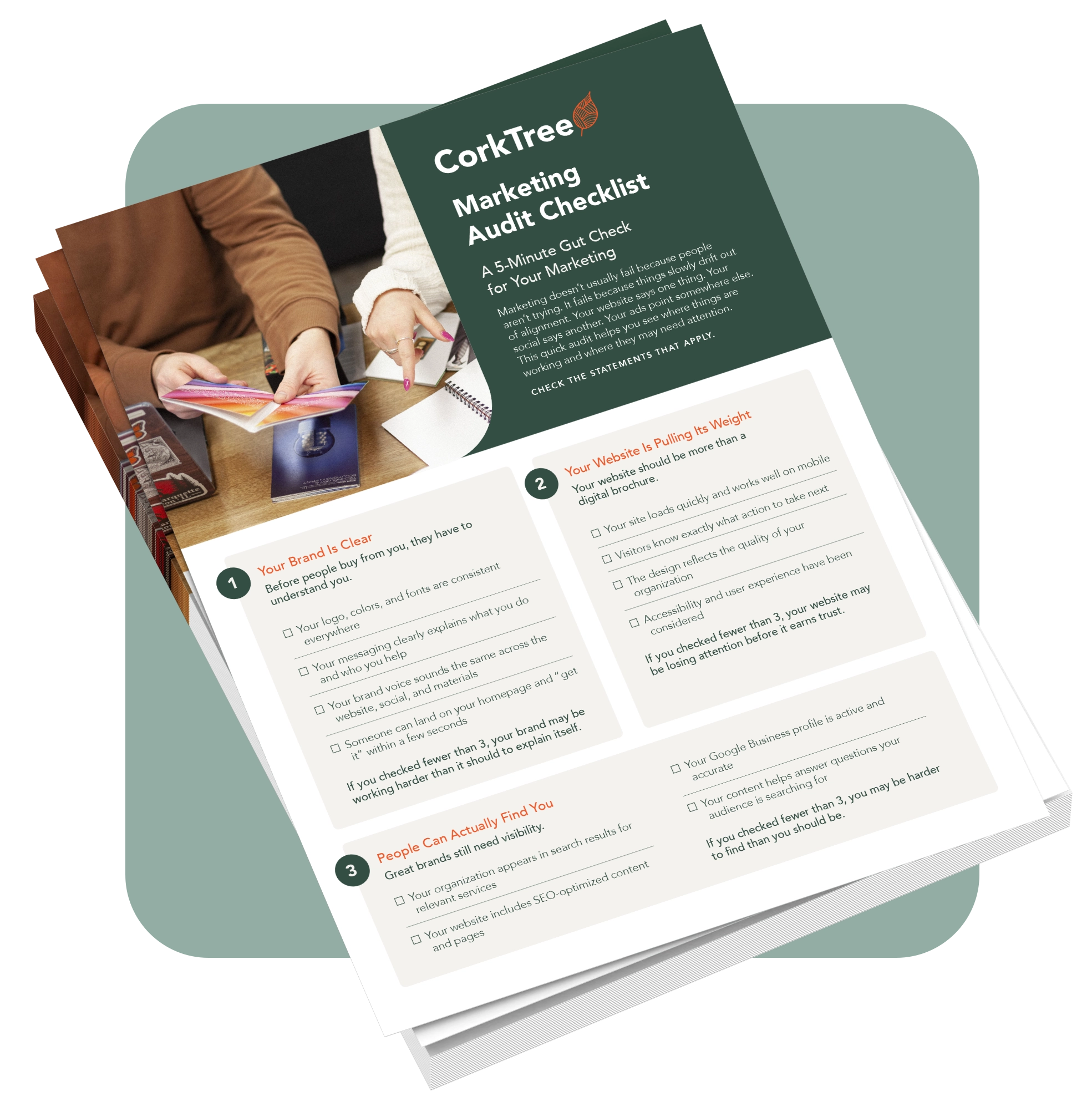
Is Your Website Helping Visitors Take the Next Step? Use This Website Review Checklist
Your website may look polished, rank for relevant searches, and attract steady traffic. But is it turning the right visitors into real business opportunities? If people land on your website but do not call, complete a form, schedule an appointment, or request a quote, something may be breaking down along the way. The issue could be unclear messaging, a hard-to-find call to action, a slow page, weak trust signals, or even a form that never reaches the right person. A lead generation website audit reviews how effectively your site attracts the right visitors, communicates value, builds trust, encourages action, and captures measurable inquiries. Use this website review checklist to find the weakest link in that journey—and decide what to improve first.
What Is a Lead Generation Website?
A lead generation website turns interested visitors into contacts your organization can continue engaging. It provides useful information and guides people toward a meaningful next step, such as:
- Requesting a quote or consultation
- Scheduling an appointment or demonstration
- Calling the business
- Registering for an event or visit
- Downloading a useful resource
The right conversion depends on the organization. A professional services firm may prioritize consultation requests, while a healthcare organization may value appointment calls and a university may focus on program inquiries. Simply adding a contact form is not enough. The offer, content, design, functionality, and follow-up process must work together.
First, Define What Counts as a Qualified Lead for Your Business
Before reviewing individual pages, decide what you are measuring:
- What action do you most want a prospective customer to take?
- What information does your team need to determine whether that person is a good fit?
- Who is responsible for responding, and what should happen next?
A newsletter signup, job application, vendor solicitation, and consultation request may all appear as conversions, but they do not carry the same business value. Once you define the desired action, review the website through five connected areas: promise, path, proof, performance, and pipeline.
Website Review Checklist: Five Areas That Affect Lead Generation
1. Promise: Is Your Message Immediately Clear?
When someone visits a priority page, can they quickly tell what you offer, who you help, why it matters, and what to do next?
Try a five-second test. Show your homepage or an important landing page to someone unfamiliar with your organization for five seconds. Then ask what the organization does, who it serves, and what action the visitor should take. Unclear answers may point to vague headlines, internal jargon, or too many competing messages.
For example, “Solutions Built for Your Future” sounds polished but says little about the actual service. A more specific headline can identify the audience, offer, and benefit without making visitors search for context. Try rewriting the primary headline around the customer's need, then pair it with one clear next step.
2. Path: Is It Easy to Take Action?
Once visitors understand the offer, acting on it should feel simple. Ask:
- Does each priority page have a clear primary call to action?
- Does the button explain what will happen next?
- Is it easy to find and use on a phone?
- Does the form ask only for information the team will use?
- Do the confirmation message and thank-you page work?
Descriptive calls to action such as “Request a Quote” or “Download the Guide” set clearer expectations than “Submit” or “Learn More.” It’s also better for accessibility and SEO.
Form length also requires judgment. Fewer fields reduce effort, but a specialized business may need additional details to identify qualified opportunities. Collect enough information to support the next step without making the form feel like an interrogation.
3. Proof: Does Your Website Earn Trust?
Marketing claims are easy to make. Evidence helps people believe them. Relevant proof may include:
- Testimonials and reviews
- Case studies or project examples
- Credentials, certifications, awards, and affiliations
- Team biographies and subject-matter expertise
- Accurate contact and location information
- Privacy, accessibility, or compliance information
Specific proof is more persuasive than decoration. A case study that explains the challenge, work, and outcome says more than a vague claim of “proven results.” Place that evidence near the claim or call to action it supports instead of making visitors search for it elsewhere.
Back in the day, Cork Tree’s website gave every visitor the same next step: “Contact.” The form asked for a first name, last name, and email address… and not much else. While it was easy to complete, it left our team sorting through spam, inquiries with the wrong intent, and messages with too little context to understand what the person actually needed.
Today, our website offers three conversion paths based on a visitor’s level of interest. “Book a Call” gives high-intent prospects a clear way to discuss their marketing needs with our team. Our contact form serves people who may not be ready to schedule a conversation while gathering helpful details, such as their business name, budget, and reason for reaching out. Our transitional call to action offers an even lower-commitment option. Visitors can download a useful resource, get a feel for who Cork Tree is, and see how we can help—in other words, they can date us before they marry us.
The goal was not simply to add more calls to action. It was to create the right next step for visitors at different stages of the decision-making process.
4. Performance: Can People and Search Engines Use the Website?
Even strong messaging cannot work if a page loads slowly, shifts while someone is trying to click, breaks on a phone, or never appears in search results.
Review mobile responsiveness, accessibility, broken links, page titles, headings, internal links, indexability, content quality, and loading performance. Google's Core Web Vitals provide useful benchmarks: the main content should load within 2.5 seconds, interactions should respond within 200 milliseconds, and visual movement should remain at a Cumulative Layout Shift score of 0.1 or less. Google evaluates whether those targets are met for at least 75% of page visits across mobile and desktop.
Use PageSpeed Insights to check key pages, but do not treat one score as the entire audit. A fast page can still confuse visitors. Technical performance, content, accessibility, search visibility, and user experience should be evaluated together.
The same principle applies to AI search. Google says websites do not need special AI files or unique schema to appear in its generative search features. Crawlable pages, original and useful content, internal links, accurate structured data, and a good page experience still matter. Optimizing for people, traditional search, and AI discovery should not be three separate projects.
This may sound a bit overwhelming, especially if you have a large website. Start by reviewing priority pages in Google Search Console and PageSpeed Insights, then compare those findings with how visitors actually use the pages.
5. Pipeline: What Happens After Someone Converts?
The website's job does not end when someone presses “Submit.” If the inquiry is not measured, delivered, assigned, and answered, that conversion may never become a business opportunity.
Confirm that:
- Your analytics platform records meaningful conversion events correctly.
- Calls, forms, downloads, and appointments are distinguishable.
- Form notifications reach the correct person or system.
- Leads enter the appropriate sales, intake, email, or CRM process.
- Spam is separated from qualified inquiries.
- Someone owns the follow-up and knows the expected response time.
If every button click is reported as a success, it becomes difficult to see which marketing activities influence qualified leads. Privacy and consent requirements should also guide what you collect and track, especially when the website handles sensitive personal, health, financial, or student information.
How Should You Prioritize Website Audit Findings?
A website content audit checklist can reveal more issues than your team can address at once. Sort each finding according to:
- Business impact: Could it prevent a qualified visitor from finding the website, understanding the offer, or converting?
- Reach: Does it affect one low-traffic page or a major customer journey?
- Effort: Is it a quick correction or a larger strategic or technical project?
Start with high-impact improvements that can be completed efficiently. Fixing a broken form, clarifying a call to action, or correcting missing tracking may deserve attention before a visual refresh.
Low lead volume also does not automatically mean you need a new website. The cause could be limited qualified traffic, unclear positioning, a weak offer, technical problems, or slow follow-up. Let the evidence determine whether you need focused optimization, new content, technical repairs, or a complete redesign.
When Is It Time for a Professional Website Audit?
An outside perspective and website development services may be helpful when traffic is growing, but qualified inquiries are not, your team cannot connect leads to pages or channels, paid campaigns lead to pages that underperform, or the website no longer reflects your audience and services.
A professional audit should not automatically end with a recommendation to rebuild everything. It should explain what is working, identify what is not, and clarify which improvements deserve your time and budget first.
Turn Your Website into a Harder-Working Part of Your Marketing
A strong lead generation website connects the entire customer journey. The right people can find it, the message makes sense, the experience builds confidence, and taking action is easy. Your team can then measure, receive, and respond to the opportunity.
At Cork Tree Creative, we look beyond a single page or metric. Our team brings together website strategy, copywriting, design, development, search engine optimization, digital advertising, and analytics to understand how your marketing works as a whole.
Not sure which part of your website is holding you back? Book a call and take the guesswork out of your next step.
More Questions About Website Lead Generation
How do I audit my website for lead generation?
Define what qualifies as a valuable lead, then review the website's promise, path, proof, performance, and pipeline. Determine whether visitors can find the site, understand the offer, trust the organization, act easily, and enter a working follow-up process. Test important forms and calls to action yourself.
How often should I audit my website?
Complete a focused website audit at least annually and after major changes to your business, audience, services, campaigns, brand, or technology. Test high-priority forms, call tracking, and conversion events more frequently so a small technical problem does not quietly cost you leads.
Does a website with few leads need a full redesign?
Not necessarily. Low lead volume may result from limited qualified traffic, unclear messaging, weak calls to action, form friction, technical issues, inaccurate tracking, or poor follow-up. Audit the full journey before committing to a redesign.
Can ChatGPT perform a website audit?
AI tools can help review supplied copy, organize observations, and identify questions worth investigating. They cannot replace accurate analytics, Search Console data, direct technical and accessibility testing, customer insight, or experienced strategic judgment. Treat AI output as a starting point, and verify its recommendations.