Your website may look polished, rank for relevant searches, and attract steady traffic. But is it turning the right visitors into real business opportunities? If people land on your website but do not call, complete a form, schedule an appointment, or request a quote, something may be breaking down along the way. The issue could be unclear messaging, a hard-to-find call to action, a slow page, weak trust signals, or even a form that never reaches the right person. A lead generation website audit reviews how effectively your site attracts the right visitors, communicates value, builds trust, encourages action, and captures measurable inquiries. Use this website review checklist to find the weakest link in that journey—and decide what to improve first.
A lead generation website turns interested visitors into contacts your organization can continue engaging. It provides useful information and guides people toward a meaningful next step, such as:
The right conversion depends on the organization. A professional services firm may prioritize consultation requests, while a healthcare organization may value appointment calls and a university may focus on program inquiries. Simply adding a contact form is not enough. The offer, content, design, functionality, and follow-up process must work together.
Before reviewing individual pages, decide what you are measuring:
A newsletter signup, job application, vendor solicitation, and consultation request may all appear as conversions, but they do not carry the same business value. Once you define the desired action, review the website through five connected areas: promise, path, proof, performance, and pipeline.
When someone visits a priority page, can they quickly tell what you offer, who you help, why it matters, and what to do next?
Try a five-second test. Show your homepage or an important landing page to someone unfamiliar with your organization for five seconds. Then ask what the organization does, who it serves, and what action the visitor should take. Unclear answers may point to vague headlines, internal jargon, or too many competing messages.
For example, “Solutions Built for Your Future” sounds polished but says little about the actual service. A more specific headline can identify the audience, offer, and benefit without making visitors search for context. Try rewriting the primary headline around the customer's need, then pair it with one clear next step.
Once visitors understand the offer, acting on it should feel simple. Ask:
Descriptive calls to action such as “Request a Quote” or “Download the Guide” set clearer expectations than “Submit” or “Learn More.” It’s also better for accessibility and SEO.
Form length also requires judgment. Fewer fields reduce effort, but a specialized business may need additional details to identify qualified opportunities. Collect enough information to support the next step without making the form feel like an interrogation.
Marketing claims are easy to make. Evidence helps people believe them. Relevant proof may include:
Specific proof is more persuasive than decoration. A case study that explains the challenge, work, and outcome says more than a vague claim of “proven results.” Place that evidence near the claim or call to action it supports instead of making visitors search for it elsewhere.
Back in the day, Cork Tree’s website gave every visitor the same next step: “Contact.” The form asked for a first name, last name, and email address… and not much else. While it was easy to complete, it left our team sorting through spam, inquiries with the wrong intent, and messages with too little context to understand what the person actually needed.
Today, our website offers three conversion paths based on a visitor’s level of interest. “Book a Call” gives high-intent prospects a clear way to discuss their marketing needs with our team. Our contact form serves people who may not be ready to schedule a conversation while gathering helpful details, such as their business name, budget, and reason for reaching out. Our transitional call to action offers an even lower-commitment option. Visitors can download a useful resource, get a feel for who Cork Tree is, and see how we can help—in other words, they can date us before they marry us.
The goal was not simply to add more calls to action. It was to create the right next step for visitors at different stages of the decision-making process.
Even strong messaging cannot work if a page loads slowly, shifts while someone is trying to click, breaks on a phone, or never appears in search results.
Review mobile responsiveness, accessibility, broken links, page titles, headings, internal links, indexability, content quality, and loading performance. Google's Core Web Vitals provide useful benchmarks: the main content should load within 2.5 seconds, interactions should respond within 200 milliseconds, and visual movement should remain at a Cumulative Layout Shift score of 0.1 or less. Google evaluates whether those targets are met for at least 75% of page visits across mobile and desktop.
Use PageSpeed Insights to check key pages, but do not treat one score as the entire audit. A fast page can still confuse visitors. Technical performance, content, accessibility, search visibility, and user experience should be evaluated together.
The same principle applies to AI search. Google says websites do not need special AI files or unique schema to appear in its generative search features. Crawlable pages, original and useful content, internal links, accurate structured data, and a good page experience still matter. Optimizing for people, traditional search, and AI discovery should not be three separate projects.
This may sound a bit overwhelming, especially if you have a large website. Start by reviewing priority pages in Google Search Console and PageSpeed Insights, then compare those findings with how visitors actually use the pages.
The website's job does not end when someone presses “Submit.” If the inquiry is not measured, delivered, assigned, and answered, that conversion may never become a business opportunity.
Confirm that:
If every button click is reported as a success, it becomes difficult to see which marketing activities influence qualified leads. Privacy and consent requirements should also guide what you collect and track, especially when the website handles sensitive personal, health, financial, or student information.
A website content audit checklist can reveal more issues than your team can address at once. Sort each finding according to:
Start with high-impact improvements that can be completed efficiently. Fixing a broken form, clarifying a call to action, or correcting missing tracking may deserve attention before a visual refresh.
Low lead volume also does not automatically mean you need a new website. The cause could be limited qualified traffic, unclear positioning, a weak offer, technical problems, or slow follow-up. Let the evidence determine whether you need focused optimization, new content, technical repairs, or a complete redesign.
An outside perspective and website development services may be helpful when traffic is growing, but qualified inquiries are not, your team cannot connect leads to pages or channels, paid campaigns lead to pages that underperform, or the website no longer reflects your audience and services.
A professional audit should not automatically end with a recommendation to rebuild everything. It should explain what is working, identify what is not, and clarify which improvements deserve your time and budget first.
A strong lead generation website connects the entire customer journey. The right people can find it, the message makes sense, the experience builds confidence, and taking action is easy. Your team can then measure, receive, and respond to the opportunity.
At Cork Tree Creative, we look beyond a single page or metric. Our team brings together website strategy, copywriting, design, development, search engine optimization, digital advertising, and analytics to understand how your marketing works as a whole.
Not sure which part of your website is holding you back? Book a call and take the guesswork out of your next step.
Define what qualifies as a valuable lead, then review the website's promise, path, proof, performance, and pipeline. Determine whether visitors can find the site, understand the offer, trust the organization, act easily, and enter a working follow-up process. Test important forms and calls to action yourself.
Complete a focused website audit at least annually and after major changes to your business, audience, services, campaigns, brand, or technology. Test high-priority forms, call tracking, and conversion events more frequently so a small technical problem does not quietly cost you leads.
Not necessarily. Low lead volume may result from limited qualified traffic, unclear messaging, weak calls to action, form friction, technical issues, inaccurate tracking, or poor follow-up. Audit the full journey before committing to a redesign.
AI tools can help review supplied copy, organize observations, and identify questions worth investigating. They cannot replace accurate analytics, Search Console data, direct technical and accessibility testing, customer insight, or experienced strategic judgment. Treat AI output as a starting point, and verify its recommendations.
When it comes to data analytics in marketing, organizations are unlikely to face a shortage. Reports analyzing ad campaigns, social media insights, customer relationship management (CRM) systems, and more provide a surplus of information about audiences. The challenge for many marketing professionals isn’t accessing the data, but knowing which insights matter and how to turn them into actionable insights.
Data analytics in marketing is more than a collection of numbers on a dashboard. It’s about identifying which metrics matter, understanding what they reveal about your audience, and using those insights to strengthen your organization’s visibility across platforms. We help organizations make sense of complex consumer data marketing practices and turn customer insights into more effective strategies.
By understanding what your customer data is telling you, your organization can make more informed decisions and better connect with its audiences. In a competitive landscape, putting those insights into action can be key to outperforming rivals and building a stronger marketing strategy. Discover the importance of understanding consumer data and how it can help drive smarter marketing decisions.
Marketing data that is easy to understand and analyze can help organizations identify valuable insights and make more informed decisions. Some of these insights may even appear in featured snippets, short text excerpts that provide users with direct answers at the top of search engine results pages (SERPs). Marketing data can be quantitative or qualitative, ranging from clicks and conversions to customer reviews and survey responses. Understanding the different types of data available can help marketing and communications professionals determine which metrics are most useful in meeting their goals.
Examples of data analytics in marketing include:
For an organization to strengthen customer experiences and relationships while standing out to new audiences, marketing professionals need to understand the metrics that reveal consumer behaviors, preferences, and purchasing trends. The importance of marketing data lies in how effectively organizations use these insights to better understand their audiences and make informed decisions that support broader business goals.
Consider what you want your marketing to accomplish. Do you want to make a lasting impression on new audiences? Do you want to strengthen your reputation and remain memorable to customers who already know your organization?
If you answered yes to either question, it’s important to recognize that data and creativity are not competing forces. Good data gives creative teams a clearer understanding of the challenges they need to solve, while creativity helps turn those insights into compelling campaigns, experiences, and messaging.
Specifically, data-driven organizations can help them:
With these opportunities in mind, use marketing data to catalyze your next business decision or strategic initiative. Looking beyond the metrics you encounter in everyday reports can reveal opportunities that may not be obvious through day-to-day work alone. Strong marketing professionals use data to support and validate their decisions, but great ones, such as our creative team at Cork Tree Creative, use it to uncover new possibilities and identify chances for growth.
Oftentimes, business professionals fail to think proactively about data analytics for marketing and how they can be used to identify problems early on. That being said, organizations usually open an analytics platform expecting a set of numbers to pop out at them and outline something interesting. A better approach is to begin with a solid question that needs to be answered beforehand and select a platform tailored to your organization’s specific problem.
Examples of valuable business questions to better understand how marketers use data to identify goals while still supporting larger business strategies may be found below:
| Business Question | Relevant Marketing Data |
| Should we invest more in a particular channel? | Qualified leads, conversions, acquisition cost, and revenue—not impressions alone |
| Is our website helping people take the next step? | Conversion rate, user paths, form completions, calls, and exit points |
| Which services are customers most interested in? | Search queries, page traffic, sales inquiries, downloads, and CRM data |
| Is our message resonating? | Engagement quality, click-through rates, customer questions, sales feedback, and conversion behavior |
| Are we reaching the right audience? | Lead quality, customer attributes, CRM outcomes, and audience-level campaign performance |
Below are six Cork Tree-friendly steps that turn simple customer data into successful, data-driven marketing tactics.
Begin with the end. Think about which marketing outcomes would benefit your organization the most. Whether it’s increasing event registrations, improving customer retention, or any other result that requires a marketing data analysis, it’s crucial to have measurable yet reasonable business outcomes.
Next, select a focused set of key performance indicators (KPIs) that directly connect to the overall marketing outcome you identified in step one. Rather than tracking every available metric, prioritize the measures that provide meaningful insight into whether your marketing efforts are moving you toward your goal.
Examples of KPIs and their relevance to common marketing goals include:
Hand in hand with step two, identifying the right KPIs and metrics tells only part of the story. To understand why your marketing performance looks the way it does, and what you can do to improve it, compare your results across other channels. This additional context can help reveal patterns that may not be apparent when looking at just one metric.
Consider comparing your marketing data analytics by:
It’s also important to account for external factors that may influence your results. Seasonality, budget changes, promotions, website updates, economic conditions, and shifts in the broader market can all affect consumer behavior and marketing performance. Considering these factors can help you determine why your data looks the way it does and distinguish meaningful trends from temporary fluctuations.
The hardest part of interpreting data analytics in marketing is looking beyond the numbers rather than accepting them at face value. Identifying the “why” behind a result and reporting on more than simply what happened is what takes a marketing professional’s analysis to the next level. For example:
The list goes on. Asking questions like these when analyzing data from marketing platforms can help uncover the context behind your results and lead to more informed decisions. Most importantly, looking beyond surface-level metrics can help you avoid confusing correlation with causation and focus on the insights that actually matter to your organization.
Once you’ve identified and interpreted the marketing data most relevant to your desired outcomes, the next step is turning meaningful insights into action. Data analytics in marketing is most valuable when it informs a specific decision, question, or experiment. Instead of simply documenting what the data shows, determine how you can use each insight to improve performance, test an assumption, or uncover a new opportunity.
Potential actions include:
Marketing analysis is an ongoing cycle that begins with identifying a new opportunity or area for improvement within your organization. Once you’ve taken action, document the changes you’ve made, allow enough time to collect meaningful results through data-driven marketing tactics and strategies, and then evaluate whether those efforts improved the desired outcome.
This process creates a continuous feedback loop: analyze the data, identify an opportunity, take action, measure the results, and refine your approach based on what you learn. Over time, this approach can help marketing professionals make more informed decisions and improve their performance.
When presenting a marketing data analysis, focus on relatable, real-world examples that clearly demonstrate how customer data can inform smarter marketing decisions. Rather than relying on case studies built around massive datasets or complex predictive models, use straightforward examples that show the practical impact of data-driven strategies.
High-quality, real-life case studies can also strengthen credibility and help demonstrate measurable results. In fact, companies that publish high-quality case studies have been shown to generate 45% more qualified leads than those that don’t, making them a valuable tool for demonstrating to prospects what effective customer data strategies can achieve.
Informational keywords accounted for 60% of unique search queries, indicating that most searches are driven by people seeking information rather than actively looking to purchase a product or service. This highlights an opportunity for marketing professionals to meet potential customers earlier in the decision-making process by creating dedicated service pages, FAQs, or blog content that answers their questions and provides more information about the brand.
Digital advertising reports can make a campaign with the most clicks or lowest cost per click look like the obvious winner. However, those metrics do not always reflect the quality of the traffic being generated. For instance, one ad campaign may drive a high volume of inexpensive website visits, while another may produce fewer clicks but generate more qualified inquiries. Looking beyond surface-level activity allows the organization to prioritize the campaign that is contributing more directly to its business goals—even if its cost per click is higher.
A social media post does not need to reach the largest possible audience to be valuable. A behind-the-scenes post, for example, may earn fewer impressions than a general industry post but generate more thoughtful comments, shares, profile visits, or conversations with prospective customers. If the organization’s goal is to build relationships or encourage inquiries, those higher-quality interactions may matter more than broad reach alone. Comparing the response to different content types can help shape a social media strategy around what genuinely connects with the intended audience.
Email metrics can show which messages attract attention, while CRM data helps connect that engagement to what happens later in the customer journey. Suppose CRM records reveal that leads from a particular industry have a shorter sales cycle or higher close rate. The marketing team could use that insight to develop industry-specific email content, landing pages, case studies, or outreach. Connecting email engagement with lead quality and sales outcomes creates a more complete picture than open and click rates alone can provide.
Not every useful marketing insight comes from a digital platform. Repeated customer questions, common sales objections, online reviews, survey responses, and conversations with customer-facing employees can reveal needs that a dashboard cannot fully explain. If several prospective customers misunderstand the same service, for example, the organization may need clearer website copy, sales materials, or educational content. Pairing this qualitative feedback with quantitative data helps marketers understand not only what audiences are doing, but what may be influencing their decisions.
Even accurate data can lead to a poor decision when viewed without a clear goal or sufficient context. Some of the most common marketing data mistakes include:
Organizations should also collect and use customer data responsibly. Pay attention to consent, privacy, data accuracy, and applicable requirements, and prioritize trustworthy first-party data gathered directly through customer interactions. Responsible data practices protect your audience while giving your team more dependable information to work with.
When a marketing report raises more questions than it answers, the first instinct may be to add another platform or collect even more information. In reality, many organizations already have enough data to make better decisions. The information is simply scattered across systems, reported inconsistently, or disconnected from broader business goals.
Before investing in another tool, consider whether your organization needs clearer goals, more reliable tracking, cleaner data, consistent reporting, or stronger collaboration between marketing and sales. An outside perspective can also help connect information across channels, identify gaps, and separate meaningful patterns from distracting metrics.
A Cork Tree Creative marketing audit brings those pieces together. By reviewing your current brand, website, campaigns, content, analytics, and competitive landscape, our team can help you understand what is working, where opportunities may be hiding, and which next steps make the most sense for your organization.
Marketing data should make your next decision clearer, not leave your team with a longer list of numbers to report. The strongest strategies combine measurable performance and customer insight with the experience, creativity, and human judgment needed to interpret what the data actually means.
Start with the question your organization needs to answer, focus on the information that supports it, and use what you learn to take one thoughtful next step. Then, measure the result and keep refining. That is how marketing data becomes more than a report—it becomes a practical tool for growth.
Not sure what your marketing data is telling you or whether you are measuring the right things? Cork Tree Creative can take a closer look at your current marketing efforts, identify opportunities, and help turn your findings into a strategy you can actually use. Explore our marketing audit services or book a call to get started.
Data analytics for marketing is the process of analyzing relevant, organized data to uncover meaningful insights that can help your organization achieve its broader marketing goals. Rather than simply collecting and reporting on metrics, it involves identifying patterns, understanding their meaning, and using those insights to make more informed marketing decisions.
As discussed throughout this blog, organizations can use customer data to make informed decisions about their marketing goals, strategies, and efforts. This data can come from a variety of sources, including website behavior, search activity, purchase history, CRM records, campaign engagement, surveys, reviews, and direct customer conversations.
Marketers begin with a specific business goal and identify the metrics most closely connected to it. They then compare results, look for patterns, and consider factors such as audience, channel, timing, and customer feedback. From there, they choose a measurable action, test it, and evaluate whether it improved the desired outcome.
Marketing data consists of raw facts and measurements, such as website visits, click-through rates, form submissions, or customer responses. A marketing insight is the useful conclusion drawn from that information. It explains what the data may mean, why it matters to the organization, and how it could influence the next marketing decision.
Rather than treating search engine optimization (SEO), advertising, websites, communications, and other marketing strategies as separate initiatives, today’s healthcare marketing trends reflect a more integrated approach, bridging these tactics together as components of one cohesive marketing strategy. Success in healthcare marketing requires organizations to balance patient trust, regulatory compliance, emerging technologies, and measurable business outcomes. As the industry evolves, marketing professionals and healthcare executives must adopt unified strategies that strengthen online visibility while maintaining meaningful patient relationships.
In the era of artificial intelligence (AI) overviews and generative search, healthcare marketing is evolving faster than ever to meet changing privacy regulations, advertising requirements, and the rising expectations of both healthcare organizations and patients. Leading healthcare entities are integrating marketing efforts into a unified strategy that also focuses on new technologies, adapts to changing patient behaviors, and delivers consistent brand experiences across platforms.
Below, we explore the latest healthcare marketing insights, strategies, and healthcare marketing trends shaping the industry in 2026. From the growing influence of online reputation management and convergence of public relations with SEO to the transformative impact of AI-powered search, these developments are redefining how healthcare organizations connect with patients and communities. As a healthcare marketing agency, Cork Tree helps organizations navigate this rapidly changing landscape with data-driven, integrated strategies designed to support long-term growth. Discover how a strategic marketing partnership can position your organization for success in the future of healthcare marketing.
A patient’s physical and mental well-being is among the most important aspects of their life, making trust a critical factor when choosing a healthcare provider. Before scheduling an appointment, patients often evaluate a healthcare organization through its digital presence, including online reviews, physician ratings, Google Business Profile, and patient testimonials. A strong, credible online reputation built on these trusted sources helps establish confidence long before a patient walks into the office.
Google’s EEAT framework (Experience, Expertise, Authoritativeness, and Trust) has long been an important consideration for healthcare organizations looking to improve search visibility. To strengthen your organization’s presence in search results, content should demonstrate clinical expertise, provide valuable information, and establish credibility with both patients and search engines. By consistently showcasing authority across digital channels, healthcare organizations can improve their ability to be discovered and understood in a competitive search-based industry.
The latest changes are redefining healthcare digital marketing trends and reinforcing the importance of brand credibility as a long-term marketing strategy. As the future of healthcare marketing continues to evolve, organizations should prioritize the following:
One of the most notable healthcare advertising trends is the growing integration of SEO, branding, and public relations into a unified marketing strategy. While these disciplines were once viewed as separate efforts to build brand awareness and improve search visibility, today’s healthcare organizations recognize that they work best together.
Sue Webb, Director of Strategy at Cork Tree Creative, discusses the rise of this integrated marketing strategy.
“Healthcare organizations can no longer treat SEO, public relations, advertising, reputation, and their website as separate efforts. All of these marketing tactics affect how patients find care, whether they trust an organization, and whether they ultimately choose it,” Webb states. “The organizations seeing the best results are connecting these efforts and making sure they all support the same goals.”
Modern public relations extends beyond crisis communications and media relations to include community outreach, industry awards, speaking engagements, thought leadership, and partnerships. These efforts do more than generate positive press; they create the third-party credibility that influences how patients and search engines evaluate a healthcare organization. Components like high-quality media coverage and mentions from trusted organizations strengthen a brand’s online authority, while community engagement reinforces its reputation across digital channels. As AI-powered search engines prioritize trustworthy sources, an integrated public relations strategy has become an essential driver of digital visibility.
AI overviews are now prominently featured at the top of many search results, and 60% of Americans say they read these AI-generated summaries before clicking through to websites. As a result, they’re changing how patients search for providers, symptoms, treatments, and healthcare organizations. If your organization’s content isn’t referenced in an AI feature, you’re more likely to miss valuable visibility during a patient’s search journey.
Traditional keyword optimization alone is no longer enough to compete in AI-powered search. Instead, organizations should structure content in formats that are easier for generative search engines to understand and reference, such as the following:
These content formats make it easier for AI search engines to identify and interpret valuable information from your website, helping strengthen your organization’s digital presence in 2026.
Keeping up with digital trends in healthcare and pharma marketing has become increasingly challenging as evolving privacy regulations and browser updates have made it more difficult to measure the performance of Google Ads and Meta campaigns. As a result, healthcare marketers have faced growing attribution challenges. One solution gaining momentum is server-side tag management (SSTM), which helps organizations collect reliable first-party data while maintaining privacy compliance policies.
By implementing SSTM, healthcare organizations can gain more accurate insights into digital advertising campaign performance, budgeting, ROI, and patient acquisition while still adhering to privacy regulations. Overall, healthcare marketers can make better-informed decisions with stronger first-party data and reliable tracking.
Healthcare organizations are held to a higher standard when it comes to protecting patient information and providing accessible digital experiences. Compliance with regulations such as HIPAA is not only a legal and ethical responsibility but also essential for building patient trust and reducing barriers to care.
As privacy regulations evolve and patient-privacy expectations continue to rise, healthcare marketers must ensure their websites prioritize compliance, transparency, and usability. Key components to evaluate are:
Compliance is more than a regulatory requirement, as it provides opportunities to build patient trust, expand your audience, and create a better overall digital experience. Ensuring every user is included is what turns an ordinary website into a great one.
The continued growth of visual content is reshaping healthcare social media trends by helping organizations build credibility, establish trust, and create stronger relationships with patients. Short-form videos, physician introductions, patient testimonials, recruitment videos, and behind-the-scenes content give future patients a more authentic view of a healthcare organization before they schedule an appointment. By showcasing providers, staff, and the patient experience through storytelling, healthcare organizations can humanize their brand, making it easier for new patients to walk through the door.
When searching for healthcare, convenience often plays a major role in a patient’s decision-making process. Many patients begin their search by looking for providers close to home, making local search visibility a critical component of any healthcare marketing strategy. To attract more patients, healthcare organizations should optimize their Google Business Profile, maintain accurate location and physician pages, invest in local SEO, and create content catered to the communities they serve. These efforts, combined with active community involvement, can improve local search rankings and strengthen patient trust.
Today’s most successful healthcare organizations no longer treat SEO, advertising, public relations, reputation management, video, and communications as separate initiatives. Instead, they integrate these disciplines into a unified marketing strategy that builds trust, strengthens brand visibility, and delivers measurable results across every stage of a patient’s journey.
If your current marketing strategy isn’t delivering the results you expected, now is the time to evaluate what is and isn’t working. Our team helps organizations receive the results they want through integrated marketing efforts. Schedule a conversation with us today to discover how a personalized marketing strategy can help your organization increase visibility and attract more patients.
We’ve all been there. You’re browsing for a pair of shoes, close the tab, and for the next two weeks, every website, app, and scroll you are reminded of those shoes. It’s not subtle or a memorable brand experience. Retargeting ads are shown to people who have already interacted with your brand, whether they visited your website, watched a video, or engaged with a social post. Because these users already know who you are, they’re a warmer audience than cold traffic.
This warmth translates to results. Retargeted users consistently convert at much higher rates than first-time visitors. They’ve already shown interest; your ad is simply a well-timed reminder. When used as part of a strategy, retargeting shortens the sales cycle, reinforces brand awareness, and keeps you top of mind when a buyer is ready to make a decision.
If retargeting works so well, why do so many people complain about it? Because most campaigns are set up once and left to run, with little thought given to the experience on the other end.
Here’s what typically goes wrong:
The simple fix is: retarget with intention.
Most retargeting problems aren’t platform problems, but rather strategy problems. The campaigns that frustrate users and drain budgets usually share the same handful of mistakes. The good news is that fixing them isn’t complicated. It just requires being intentional about how you structure your campaigns from the start. Here are some core best practices that separate retargeting campaigns that convert from ones that are quietly hurting your brand.
More impressions don’t equal more conversions. Instead, they actually translate to more annoyance. Most platforms let you cap how many times a user sees your ad within a set time period. A good rule of thumb is 3-5 impressions per week, adjusted based on your campaign data. Once someone has seen your ad enough times without acting, serving it again is unlikely to change their mind and may even push them further away.
This should be a non-negotiable. As soon as someone completes a purchase, submits a form, or takes the action you were targeting, they should be removed from that audience immediately. Continuing to advertise to them wastes the budget and creates a frustrating experience. Segment your converted users into separate lists, because they’re candidates for upsell or retention campaigns, not the same conversion push.
Not everyone who visits your website is in the same place in their decision-making journey, and your messaging shouldn’t treat them like they are. At a minimum, consider breaking retargeting audiences into three groups:
Ad fatigue is real. When users see the same image, headline, and copy week after week, engagement drops, and perception of your brand suffers. Build a rotation of at least two to three creative variations per audience, and refresh them regularly—every three to four weeks is a solid baseline. Even a simple swap of visuals or a rewritten headline can reset engagement meaningfully.
Match your retargeting window to your actual buying cycle. If your product is a considered purchase with a two-week decision window, a 90-day retargeting window is overkill and could be perceived as annoying. Shorter windows often perform better because they capture users when they’re most likely to be evaluating their options. Think critically about when your audience is actually making decisions, and build your time windows around that.
The instinct in retargeting is to push a deal or drive urgency. Sometimes that’s the right call, but not always. For users who aren't ready to convert, a hard sell can feel off-putting. Mix in softer touchpoints:
Campaigns that balance promotional and value-driven messaging tend to outperform those that only push conversions.
The best retargeting campaigns don't feel like advertising. Instead, they hold relevance. A user who abandons a cart sees an ad that speaks to exactly why they were hesitant. A blog reader gets a follow-up that goes deeper on the topic they were exploring. A returning visitor is welcomed back with something new, not the same message they ignored the week prior.
This kind of precision requires more than platform setup; it requires an intentional strategy.
When your retargeting campaigns are built with the user experience in mind, they stop feeling like follow-up ads and start feeling like timely, helpful reminders. That’s the difference between a campaign that converts and one that costs you credibility.
Yes, but the bar has gotten higher.
Users are more ad-literate than ever. They recognize retargeting. They know when they’re being followed across the internet, and they’re quicker to tune out (and develop negative feelings about) brands that do it poorly. Competition for digital ad inventory continues to increase, making strategic execution more important than simply showing up.
The brands winning with retargeting in 2026 aren’t necessarily the ones spending the most… they’re the ones spending the most thoughtfully. They’re segmenting audiences, capping frequency, refreshing creative, and measuring what actually works. The result is lower wasted spend, better audience relationships, and campaigns that improve over time rather than burning out.
Retargeting isn’t going away. But the margin for doing it poorly is shrinking.
Retargeting is one of the highest-leverage tools in digital advertising and one of the easiest to misuse. The technical setup isn’t the hard part… the strategy behind it is.
At Cork Tree Creative, we help businesses build retargeting campaigns that are rooted in intention from the start. We help take the guesswork out of strategy, so your campaigns work harder for you, not against you. Ready to build retargeting that sticks? Book a call with our team and let’s talk about what an effective strategy looks like for you.
For Midwestern marketing teams, 2025 was a learning curve. After years of chasing flashiness, marketing trends, and experimental tactics, companies began to take a step back and see what was actually working. Across industries from manufacturing to healthcare, the message became clear: clarity, trust, and measurable results mattered more than the latest vanity metric.
Three core patterns stood out:
With last year in mind, 2025 was the year of correction, focused attention, and redirection. This sets the stage for a stronger foundation in 2026. For leaders in the Midwest, the past year was less about following a timely trend and instead holding a mirror to their strategy and asking: what works and why?
Not all trends are created equal. Some are short-lived distractions, while others deliver real, measurable results worth acting on. For Midwest companies, 2025 shed light on one thing: organic success does not come from chasing what’s new or trendy. It comes from understanding what your customers want, a common problem that you provide a solution for, truly moving the needle.
Finding the trends that mattered most in 2025 provides insight into strategy as we begin the new year. Allowing organizations to hone in on initiatives that provide value while avoiding what looks great but doesn’t perform.
Vanity metrics come and go; focusing on what has longevity keeps growth consistent. KPIs such as conversions, engagement quality, lead progression, and impact. These aren’t trends; they are essential in order to understand how they contribute to revenue and growth. Campaigns that moved the needle were ones that built trust and had influence in measurable outcomes, not just how much it was seen.
The common theme that emerges from this is: organizations prioritize substance over spectacle. Marketing no longer became about flashiness; it became about how strategy can drive organic growth. The performance of campaigns matters far more than the general presence one has.
Trust and credibility were no longer a nice addition to an organization. It became a differentiator. Audiences across the Midwest responded best to marketing that felt authentic, reliable, and consistently aligned with the organization’s values.
This emphasizes how authenticity and long-term impact go hand-in-hand. Consistent storytelling reinforces an organization’s credibility, giving it an upper hand in executing campaigns. Because of the clear, consistent messaging across the board, audiences were more likely to convert and engage with their content.
The theme here is clear: short-term attention is fleeting, long-term growth comes from a consistent message that your audience can resonate with.
In 2025, most Midwestern teams didn’t add more digital efforts; they refined and sharpened what they already had. Execution reflected an increase in demand for intent, usability, and streamlined efficiency.
Instead of increasing send volume, teams invested in segmentation and relevance. Improving list hygiene, audience-specific targeting, and intentional campaigns replaced a one-size-fits-all approach. Many organizations saw a decrease in send but an increase in engagement, proof that relevance and intentional outperforms reach and send size in markets where trust matters.
We saw a renewed focus on building a stronger website UX. We saw goals such as clearer navigation, stronger CTAs, simplified messaging, and content that centered around real customer concerns and questions. These strategic adjustments were aimed at reducing friction and supporting higher conversions. In many industries where buying cycles are long and decisions are rarely impulsive, usability and clarity have become measurable drivers of growth.
Paid media became more intentional, and Midwestern teams focused on targeting, refining creative, and aligning campaigns more closely to better support favorable outcomes. Instead of treating media as a standalone growth solution, teams used social media as a support tool to amplify its value. This resulted in better, more predictable pages and fewer wasted dollars.
As the new year is here in full effect, the challenge isn’t identifying more trends; it’s recognizing that the market has fundamentally shifted. The factors shaping 2025 are still present, but expectations from buyers are higher and tolerance for inefficiency is lower.
Across all Midwest industries, buyers are better informed, more selective, and less willing to engage with vague or generic messaging. Organizations relying on vague awareness tactics without providing a clear value proposition will continue to struggle to garner attention, including trust.
By 2026, most organizations will no longer be “new” to digital marketing. Websites, email platforms, CRM systems, and paid media outlets are already in full swing. The differentiator is no longer adopting these; it is executing and optimizing. Improvements in UX, aligning a strong message, measurable data, and responsive follow-up now are the drivers of results. Surface-level activities will no longer yield meaningful results.
In uncertain economic conditions, each dollar of your budget must work harder. This is why clearly explaining who you are, what you do, and how you can guide your customer to the finish line will support your organization’s goals.
For Midwestern organizations, seeing success truly comes from clear priorities, disciplined execution, and informed decision-making. Marketing leaders will be asked to do more than generate activity; they’ll be expected to turn a complex decision into a clear one, align marketing investments with real business outcomes, and not only build but sustain systems in order to see consistent growth.
This is where thoughtful guidance matters most. Understanding where your attention should go to optimize your organization is the difference between building momentum and being misaligned. For companies throughout the Midwest, marketing trends work best when they’re grounded in reality, not hype. We help organizations turn unpredictable change into a clear direction. By combining regional insights with strategic campaigns, we help teams turn marketing trends into a practical gameplan. As 2026 continues to move along, the message isn’t to do more; it’s to do what matters most, with confidence and purpose. Book a call today to kick off your 2026 with intention.
In the competitive business landscape, no matter how niche a product or service may seem, there is probably another company doing the same thing. If something is working for another company but not for yours, it is worth digging into with a marketing competitive analysis.
A marketing competitive analysis involves researching, evaluating, and comparing competitors’ strengths and weaknesses to better inform your strategy and provide insight for your company's future decision-making. This investigation enables you to gain a deeper understanding of your company’s strengths and weaknesses and can clarify them more effectively. In the same vein, analyzing a competitor’s weaknesses allows you to see where they are lacking and helps you avoid making those same mistakes.
While you may try to navigate this on your own, a thorough competitive analysis is best handled by a marketing agency with the tools, experience, and strategic planning to turn research into intentional action. Intent and direction through an analysis will ensure you see results. Cork Tree offers expertise in making sense of complex challenges and positioning businesses to outperform their competitors. We have a dedicated marketing team whose mission is to help your business grow and thrive. Learn more about the benefits of a marketing competitive analysis and how you can get started.
A proper, thorough marketing competitive analysis will allow your business to see a variety of opportunities and benefits, such as identifying market gaps, improving customer targeting, tracking competitor campaigns, and maximizing return on investment (ROI). According to recent research, 90% of Fortune 500 companies already use competitive intelligence to gain an advantage. Below, you will find specific reasons why a marketing competitive analysis will benefit your business.
There are many moving parts in identifying market gaps within a competitive analysis. Evaluating a competitor’s strengths and weaknesses allows you to see what is working and what isn’t, which can be helpful in seeing what is clicking within the industry. Looking into their products, services, and pricing helps you determine what would be competitive and potentially offer a unique value proposition that your industry hasn’t seen. Knowing the competition’s customer feedback helps identify unmet needs and potentially leverage them to your advantage. Understanding these factors allows your business to get a holistic approach to what can be improved and what is working.
Improving customer targeting is essential to attracting potential new business, retaining a loyal customer base, and generating new traffic to your website. Understanding potential customers' needs will help them feel heard, understood, and guided towards solutions. According to recent studies, by providing excellent customer service, 83% of customers agree that they feel more loyal to brands that respond to and resolve their complaints.
Tracking competitor campaigns and messaging allows you to get a better sense of your competitor’s digital footprint. Are their campaigns performing well? What is their outreach strategy to customers and clients? These are good questions to ask. Looking into the competitor website analysis and strategy allows you to see their voice and can help you better understand what your brand voice is—and isn’t. Analyzing their social media allows you to see what content works best for them and how it could be improved within your business.
Maximizing ROI is crucial for seeing long-term and consistent growth. By setting a specific goal for outreach and campaigns, you ensure your budget is spent on candidates who are likely to respond and interact, leading to higher conversion rates and better returns on your investment. The more efficient you are, the more of an impact you will make.
In a competitive market, understanding your rivals is just as important as understanding your strengths. This is where a solid competitor analysis framework comes in.
An example of a competitor market analysis would be comparing one brand’s service pricing to another’s. If the price is significantly higher, see what they are offering. Additionally, if the services are comparable, you could leverage the price difference and the quality of service or product you offer.
If a rival company has a dynamic online presence, do research into the SEO trends and keywords they’re using and where their strategy can fit into your business.
Companies will analyze competitors’ website traffic using tools such as SEMrush or a website review checklist to get an idea of how much traffic their website is receiving. In doing so, it helps better understand how visible a competitor is online and identifies which channels are driving their growth.
A company can have a terrific product, but if its customer perception is lacking, it opens up an opportunity to leverage it and set the business apart due to superior perception from the clientele.
A competitive analysis will only add value if it is turned into a calculated strategy. If you’re wondering how to do a competitor analysis, know that we take pride in turning raw data from market research into intentional, actionable, and practical marketing plans that drive growth and results. We invite you to connect with us, and we will work together with you to create a strategy that works. Our knowledgeable professionals will conduct a thorough analysis that ensures you stay ten steps ahead of your competition, leaving them in your rearview mirror. If you’re ready to turn intentional strategies into actionable results, book a call with our team to learn about how we can help.
With competitors and crowded markets, our marketing efforts must stand out. Unfortunately, it is too easy to hit delete, swipe away, or click into a different app when we find something boring. This has created a highly competitive market and a push toward producing engaging content. Luckily, video marketing is one of the best ways to capture your audience’s attention quickly.
According to research, people remember 95% of a message in a video but only 10% of a written message. This makes video one of the most engaging platforms because audio and video stimulate multiple human senses and emotions. Audiences want something personable and relatable, and videos allow businesses to advertise, tell their story, and show their personality all at once. Discover the benefits of using video marketing in your business strategy and how a video marketing agency can help.
Video marketing is a highly influential and powerful tool since it is so prevalent and easily accessible. The average internet user consumes 17 hours of online videos each week, which is projected to rise. To say that video is unnecessary for your business would be a lie. It not only increases sales and revenue, but it also creates trust and loyalty between your customers and your brand. Discover the top four amazing advantages of video marketing that can improve your business's success.
Strategizing to create conversations within your target audience may seem useless, but according to Invesp, word-of-mouth marketing produces over $6 trillion in annual consumer sales and accounts for 13% of consumer sales.
When your brand reaches your customers and makes an emotional connection, they will talk about it. Let your customers advertise and increase your brand awareness. Make sure to end your video with a call to action to make them want to act and stay connected with your brand.
Why do people find video marketing more appealing? 65% of the population are visual learners, so it is easier for most people to stay engaged and retain information presented in a video format. Since visuals are stored in our long-term memory, people are more influenced to act on what the video sells or promotes.
One of the best ways to increase your brand’s visibility and popularity is by incorporating SEO in your marketing video’s caption. SEO stands for search engine optimization, and it strategically picks popular keywords and phrases so your content ranks higher on search engines and is more accessible.
Companies that incorporate video on their websites rank 53% higher on search engine results pages. At Cork Tree Creative, we specialize in all SEO services and have the knowledge and expertise to incorporate SEO writing into your business. Hiring a specialized technical SEO agency like Cork Tree Creative will help boost your web traffic.
When your company uses video marketing, it is easier to reach a specific target audience. We customize every video to fit your business's goals and can incorporate targeted ads and language.
Video builds consumer trust and creates emotional connections so your audience continues to buy from you. According to WordStream, brands that incorporated video into their marketing strategy increased their revenue 49% faster than brands that did not.
Working alongside a video marketing agency can take your business to the next level. At Cork Tree Creative, we showcase our clients’ brands by creating successful marketing videos that connect with their target audience and drive revenue.
Our St. Louis video production team has the experience and creativity to create a video to boost your sales and visibility. Contact us to get started on your new marketing video.
At Cork Tree Creative, we consistently try to keep up with the latest trends in marketing. Learning about new ways of doing our jobs can be intimidating, but adapting and incorporating new methods can also be exciting. AI in marketing is changing how people do things, and we're here to unpack it for you.
Artificial intelligence (AI) is a tool that has completely changed the way businesses do things. AI uses machines to solve problems strategically, adapting over time to become more intelligent, just like humans. When you apply this technology to marketing, there are no limits to what you can use it for. From understanding clients' wants and needs to catering to messages to consumers, AI marketing is taking off fast and shows no signs of slowing down. Follow along as we dive deeper into how AI marketing can help your business.
By automating and streamlining marketing processes, AI allows marketing to happen with limited human oversight. The technology enables machines to create products and services for customers, strengthen existing products and services, and overall build greater customer satisfaction.
AI is generally very smart and can build on its previous knowledge, which can assist in knowing what products and services a customer is likely to approve. AI pulls ideas from across the internet for social media content creation and uses those that get the most engagement. For example, the chat generative pre-trained transformer (ChatGPT) function, added on websites, allows people to chat with machines about questions or ideas they want feedback on.
Another AI ability is reviewing what a user engages with and, in turn, giving them targeted advertisements or placing products where they are likely to purchase. You can achieve this by accumulating information over time about what users have interacted with in the past and predicting what they are likely to want in the future. AI functions faster than a human can, saving time (and money) for companies in the long run.
At Cork Tree Creative, we have begun experimenting with AI in our various service areas. For example, we have asked ChatGPT questions about how we can further enhance our SEO marketing. We’ve also explored how AI can help overcome writer’s block and provide synopses on complex topics when drafting web content. Additionally, we have tested the AI chatbot’s ability to troubleshoot lines of coding formulas for websites. By exposing ourselves to what AI is doing right now, we can adapt as an agency and create unique marketing items for our clients.
There are three main types of AI marketing: machine learning AI, big data AI, and analytics AI. AI machines use these concepts to create marketing tactics of differing advancement levels, making it easier for companies to choose which ones they want to implement. Machine Learning AI relies on machines to collect all relevant information and enhance the industry they are focused on. On the other hand, big data and analytics AI are used to show the bigger picture behind the numbers, which in marketing can help identify what is working and what isn’t. Creators developed AI marketing tools and platforms to manage the massive amounts of data being collected and to comprehend the information thoroughly.
To understand how to use AI for marketing, we must first understand what the technology can do by itself. The basis behind AI is using machines to understand information better and faster than humans. The rate at which AI machines have been learning has significantly increased in the past 10 years. This is due, in part, to the integration and reading of the data collected. Using four different learning systems, machines can learn differently than humans, and it’s becoming successful.
Putting all the systems’ information together gives a comprehensive picture of marketing data. If you program the machines to learn about your desired data, a company can gain valuable knowledge about their clients.
Cork Tree has experience with successfully managing our clients’ machine learning AI programs. We’ve utilized targeted digital advertisements, which allow us to advertise their company or product to a group of people with similar attributes. By doing this, we are reaching a population that is most likely going to invest in a service or product because it is relevant to them. This, in turn, gets our clients more business leads and a higher chance of people investing in their company, product, or service.
Data is power, and having a lot of it can be overwhelming. When AI machines learn, they understand the data, whereas humans try to understand knowledge. For example, in marketing, you create an outcome that benefits a particular company or business. To understand and use your data correctly, you must set parameters to ensure you read it correctly. If you ask a machine to collect all data, it will have no value since there is nothing to compare it to. However, when used strategically, big data and analytics AI can harness data and provide legible, insightful information that may not have been uncovered by a human alone.
Once the AI machine collects your data, you must find a way to interpret it. Again, using marketing and platform tools will give you the most comprehensive look into your data. Depending on what you are using AI for, the platform tools will create an easy and effective way to understand what it has gathered. For example, three of the top ways marketing AI is used include finding what people say about a product or business, overall market trends, and what competitors are doing.
You can use AI tools for email drafting, copywriting, digital advertising, influencer marketing, and more. The addition of search engine optimization and search engine marketing tools allows for your content to rank high when searched on Google, Bing, and similar platforms so people can find your business and services easily. AI tools can automate most of these tasks by providing suggestions or writing for your specific topic or agenda.
You may not realize it, but many programs available to the public are programmed by AI. Grammarly, a real-time writing assistant, can be relied upon to ensure that a sentence's grammar, structure, and overall flow are clear and concise. The application uses machine learning AI to understand and adapt to the language used in different industries. Grammarly creators programmed their AI system to learn sentence structure and flow to adapt to customers' needs in many languages.
Zapier is software that assists with automating tasks for businesses. It connects with 5,000 website apps to assist you in using its tools. These tools range from scheduling content to adding filters to ensuring the software is used when certain conditions are met. Additionally, the platform creates if-then scenarios so that tasks are fulfilled without oversight.
Olay’s Skin Advisor is an excellent example of an advanced AI system. This system asks customers to take a picture of their faces and answer a few questions. AI marketing will give customers feedback on what products to buy for their skin. Olay accomplishes this by AI viewing the photo and using its knowledge of data from the past to understand each person’s skin type.
We understand that not all of our clients have the time and resources to understand and implement these strategies for their company, which is where we come in. Our comprehensive marketing services and experience with using platforms similar to Zapier, among other AI marketing tools, allow us to implement an individualized plan for every client and track its ROI.
AI marketing may be the industry that is benefiting the most from the technology. Many marketing firms will use AI to generate advertisement placement, add a ChatGPT function on web pages, and perform other smaller tasks. Automating these tasks frees up employees' time to work on other tasks that require manual attention.
When deciding how to design an AI marketing strategy, you should start by finding which kind of AI you want to use. A marketing agency can help you navigate what you need to succeed. To accomplish this, you need to figure out what your goals are for your business or product. There are stand-alone machine-learning apps and integrated machine-learning apps, which many consider to be more advanced since they are an addition to an existing system of AI. Conversely, stand-alone task automation and integrated task automation apps are less developed since they work independently.
If you aim to take tasks off your plate and allow yourself more room for other tasks, using AI to help you automate your tasks is an option. If you’re looking for more intuitive and problem-solving AI, consider using one of many apps to help you with your writing, brand design, and more.
Artificial intelligence may be a step ahead of humans' ability to understand and apply data. AI marketing enhances the industry, but humans may need to assist it in moderation. AI marketing is indispensable for understanding natural language processing, ever-growing machine learning, and overall computer vision. In the future, intelligence will continue to grow and show significant leaps in predictive analysis, personalized content creation, and automated split testing.
A marketing agency can help you create an AI marketing strategy for your unique business. We can use AI to dive into your goals, needs, and desires, identify which AI marketing strategies will fit best, develop the AI marketing plan, implement and optimize the campaign, and analyze how the campaign is working over time. All these techniques can keep you ahead of the marketing game. At Cork Tree Creative, we can help you find the best uses of AI marketing for your business. Get in touch with our marketing agency to hear how we can help.
In a recent design project for our client, Archford®, our graphic designer, Amanda, utilized AI software as a starting point to create a custom avatar character. She manually photoshopped the original AI output image to better resemble the employee's facial features and structure. In the featured image above, we show the various stages of the AI output and Photoshop process to the final product.
As businesses grow and evolve, having a comprehensive marketing plan in place is essential for success. Whether you're launching a new brand, expanding into new markets, or refining your existing strategies, a well-structured marketing plan ensures your business reaches the right audience with the right message at the right time.
Before crafting a new marketing plan, take a step back and analyze what has worked for your business in the past. Evaluate your key successes and challenges, looking at data-driven insights such as customer engagement, conversion rates, and ROI. Additionally, researching your competitors' strategies can provide valuable perspective—while you don’t want to mimic their approach, identifying industry trends and best practices can be beneficial.
A strong marketing plan starts with clear objectives. Are you looking to increase brand awareness, generate more leads, increase online sales, or establish thought leadership in your industry? Defining measurable goals will help guide your strategy and provide benchmarks for success.
One of the biggest mistakes businesses make is launching new marketing initiatives without first ensuring consistency across existing platforms. Before adding new tactics to your plan, conduct a thorough audit of your branding, messaging, advertising, public relations, and social media channels. Your brand should be visually and tonally consistent, and all marketing efforts should align with your overall business objectives. For example, press releases should be distributed regularly and optimized with relevant keywords to enhance visibility.
Creative marketing ideas can be game-changers, but they require appropriate budgeting. Determine your annual marketing budget, prioritize the tactics that will deliver the highest return on investment (ROI), and allocate resources accordingly. Identify which tasks can be handled in-house and which might require outsourcing to marketing professionals. Mapping out these details in advance will streamline execution and maximize impact.
Once your marketing plan is in motion, it’s crucial to monitor performance and be flexible in adapting strategies as needed. Regularly review analytics, assess customer feedback, and make data-driven decisions to optimize results. Marketing is an ongoing process, and staying agile ensures your efforts remain effective.
Creating a comprehensive marketing strategy can be overwhelming, but you don’t have to do it alone. At Cork Tree Creative, we specialize in developing data-driven marketing plans tailored to your business’s unique needs. Contact us today, and let’s create a strategy that drives results.
Marketing is one of the best ways to ensure your business stands out in the saturated sea of competitors vying for your ideal customer’s attention. When you hire a full-service marketing agency, you’re recruiting a valuable and dedicated team that can expedite this process. Firms can turn your business idea into a personalized, actionable plan that effectively reaches your audience. Also, it will get them to do what you want and maximize your return on investment (ROI).
There are countless ways hiring a marketing agency can benefit a business. When considering ROI, a marketing agency can help you be more.
Since marketing is something every business should incorporate into their budget, you may as well pick the cost-effective option. Marketing agencies help cut overhead costs that are easily racked up by paying the salaries of full-time marketing teams. Therefore, you will only pay for the services and hours that you need by hiring an agency on a project-by-project basis.
Speed through or completely avoid hassles from the learning curve in every new business venture. If you hire a marketing agency, they’ve already been down similar roads and can inform you of potential roadblocks and ways to avoid them. They make things efficient by guiding you through pain points while simultaneously mapping out solutions in a plan of attack curated to your business goals
Effective firms have a balanced mix of creative and critical thinkers who work well together around one primary goal: to enhance your business idea. The combined reach of an entire marketing agency’s experiences, tools, specialties, and drive opens up the floor to a wealth of new ideas and results that can’t be easily duplicated.
Don’t need an entire marketing team? No problem. Pick and choose the specialized services you want us to focus on. Don’t know specifically what you need to make your business thrive? No big deal. Reliable agency account managers will listen to your hopes and dreams and bundle them into a customized proposal to fit your wants and needs, with no hidden surprises and unneeded add-ons. Full-service marketing firms should have a team of specialists that can help you with:
Experienced agencies have been marketing long enough to understand the characteristics, desires, and subtle nuances of different target audiences and how best to reach them. Good firms have a range of clients in their wheelhouse, so you can have confidence in their ability to seamlessly adapt and blend into different topics and media like industry experts. Agencies can help you identify and reach your target audience with flair, in ways that truly resonate with them. Also, they will have the data and research to back it up.
When in doubt, you can always consult a top digital marketing companies list to better vet your options. Stuck in a dense crowd of loud competitors? Hire a reputable marketing agency to amplify your voice, make a lasting impression, and secure that much-needed customer loyalty. You’ll be glad you did in the long run.
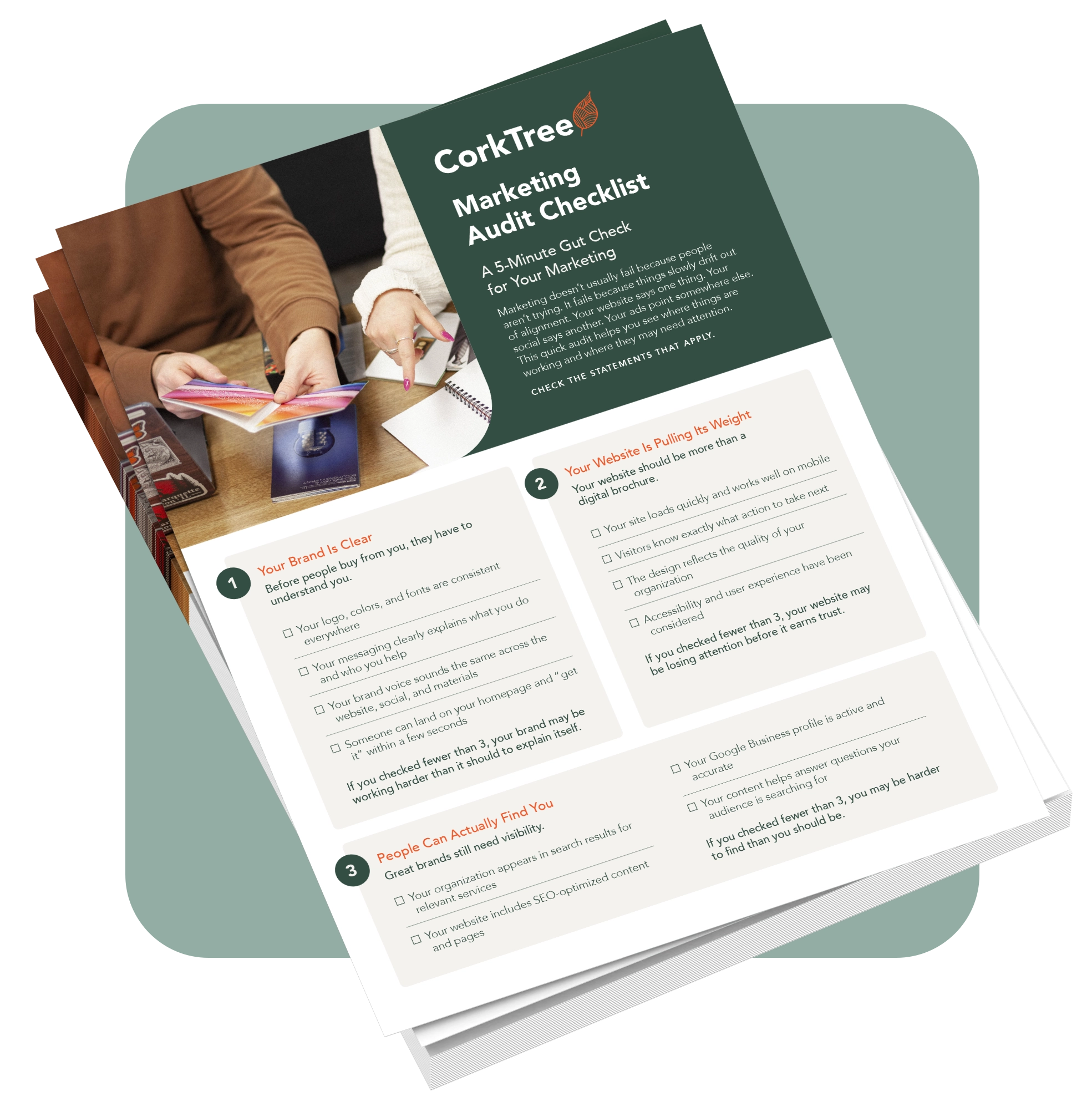
Not sure if your marketing is working the way it should? Our free marketing audit checklist gives you a quick, honest look at what’s aligned and what’s not. Download it and see where you stand.


All Rights Reserved. Design & Development by Cork Tree Creative.