If you’ve been using a local SEO strategy, but haven’t found yourself seeing consistent leads, it’s easy to feel like the rules keep changing. If you’ve ever asked yourself how to do local SEO, you’re not alone. Advice that may have worked a few years ago might not deliver the same results today, and with the constant stream of information, it can feel confusing to know which advice actually delivers results.
This is because local search has evolved.
When exploring local SEO tips, Google prioritizes three main pillars:
These three pillars explain why two very similar businesses can achieve vastly different search results. Even if your website is aesthetically pleasing, without the right proximity, relevance, and prominence, you might not show up in search when a customer is ready to convert.
Although understanding what Google prioritizes is half the battle, knowing how people in your area search is equally important. Customers are using near me inquiries and phrases based on the service they need. The good news here is that there are actionable steps to take. Understanding and improving each pillar is the foundation of what builds a strong local SEO strategy that drives conversions.
Understanding how people search enables your business to be more strategic in optimizing its local search strategy. Prospective clients and customers are using smartphones more than ever. Customers aren’t typically searching for your business’s name; they are searching for the services you provide, often location-specific searches like “near me.” This is why ranking high in local searches is essential for generating growth and new eyes on the service you provide.
People searching are often very intentional, especially those who need a service in a timely manner. Whether that’s making a call, booking an appointment, or scheduling a consultation online. For local businesses, what does this mean? It means customers need services now, and showing up higher in search results helps expedite this process: they get the service they need, and you have a new customer.
Another layer to how people search is the rise of AI. When searching for a service locally, AI and other LLM-driven results will summarize information directly on the search page. With how rapidly search itself is evolving, one of the best ways to stand out from the competition is to build your local SEO strategy so that AI search algorithms favor you rather than work against you.
The small details make a big difference. Ensuring your service descriptions are up-to-date and accurate, and that people viewing them can contact you quickly, prevents a prospective client from choosing another business. Having an optimized Google Business Profile improves your business's visibility and helps it stand out from local competition, which is crucial when two businesses offer the same services. Here you can also integrate local SEO content to make your pages informative and actionable.
With all this in mind, let’s talk about why “near me” searches are still the highest driver of leads and how to capitalize on them.
Now that we understand how people search and why “near me” queries drive high-intent leads, let’s look at what a modern local SEO strategy really entails. Today, it’s not just about checking off a list; it’s about thinking strategically, understanding audience needs, and leveraging local SEO to grow your business.
A modern local SEO strategy focuses on aligning your online presence with customer intentions:
By viewing local SEO through a strategic, data-driven lens, service-based businesses can move beyond general optimizations and build a sustainable local search presence that drives leads, builds trust, and endures over time.
SEO for service-based businesses varies greatly from other industries, such as retail or e-commerce. With this in mind, your local SEO campaign will be different from those in other industries. Companies that provide a specific service depend on high-value interactions. Unlike other markets, customers approach a service-based company typically needing a service at a specific time, which does not guarantee repeat business. In a retail setting, customers may browse multiple times. With this in mind, every interaction becomes important, because another one isn’t promised.
Here are a few things to consider when operating in service-based businesses:
Local SEO, along with the latest marketing trends and strategies, isn’t just about ranking high; it’s about understanding how people search, what drives high-intent leads, and how to convert these searches into measurable results for your business. Every lead counts; having a strategic approach to local search can be the separator between being found and being overlooked.
Our team specializes in helping service providers build local SEO strategies that are tailored to your business, community, and the needs of your customer base. From start to finish, we use real data to help you focus on what actually drives leads and conversions, so you can move the needle.
If you’re ready to capture more local customers' attention, improve your visibility, and turn search inquiries into real business, book a call with us to discuss your needs. We pride ourselves on helping businesses stand out where it matters most, right in the heart of your community.
For Midwestern marketing teams, 2025 was a learning curve. After years of chasing flashiness, marketing trends, and experimental tactics, companies began to take a step back and see what was actually working. Across industries from manufacturing to healthcare, the message became clear: clarity, trust, and measurable results mattered more than the latest vanity metric.
Three core patterns stood out:
With last year in mind, 2025 was the year of correction, focused attention, and redirection. This sets the stage for a stronger foundation in 2026. For leaders in the Midwest, the past year was less about following a timely trend and instead holding a mirror to their strategy and asking: what works and why?
Not all trends are created equal. Some are short-lived distractions, while others deliver real, measurable results worth acting on. For Midwest companies, 2025 shed light on one thing: organic success does not come from chasing what’s new or trendy. It comes from understanding what your customers want, a common problem that you provide a solution for, truly moving the needle.
Finding the trends that mattered most in 2025 provides insight into strategy as we begin the new year. Allowing organizations to hone in on initiatives that provide value while avoiding what looks great but doesn’t perform.
Vanity metrics come and go; focusing on what has longevity keeps growth consistent. KPIs such as conversions, engagement quality, lead progression, and impact. These aren’t trends; they are essential in order to understand how they contribute to revenue and growth. Campaigns that moved the needle were ones that built trust and had influence in measurable outcomes, not just how much it was seen.
The common theme that emerges from this is: organizations prioritize substance over spectacle. Marketing no longer became about flashiness; it became about how strategy can drive organic growth. The performance of campaigns matters far more than the general presence one has.
Trust and credibility were no longer a nice addition to an organization. It became a differentiator. Audiences across the Midwest responded best to marketing that felt authentic, reliable, and consistently aligned with the organization’s values.
This emphasizes how authenticity and long-term impact go hand-in-hand. Consistent storytelling reinforces an organization’s credibility, giving it an upper hand in executing campaigns. Because of the clear, consistent messaging across the board, audiences were more likely to convert and engage with their content.
The theme here is clear: short-term attention is fleeting, long-term growth comes from a consistent message that your audience can resonate with.
In 2025, most Midwestern teams didn’t add more digital efforts; they refined and sharpened what they already had. Execution reflected an increase in demand for intent, usability, and streamlined efficiency.
Instead of increasing send volume, teams invested in segmentation and relevance. Improving list hygiene, audience-specific targeting, and intentional campaigns replaced a one-size-fits-all approach. Many organizations saw a decrease in send but an increase in engagement, proof that relevance and intentional outperforms reach and send size in markets where trust matters.
We saw a renewed focus on building a stronger website UX. We saw goals such as clearer navigation, stronger CTAs, simplified messaging, and content that centered around real customer concerns and questions. These strategic adjustments were aimed at reducing friction and supporting higher conversions. In many industries where buying cycles are long and decisions are rarely impulsive, usability and clarity have become measurable drivers of growth.
Paid media became more intentional, and Midwestern teams focused on targeting, refining creative, and aligning campaigns more closely to better support favorable outcomes. Instead of treating media as a standalone growth solution, teams used social media as a support tool to amplify its value. This resulted in better, more predictable pages and fewer wasted dollars.
As the new year is here in full effect, the challenge isn’t identifying more trends; it’s recognizing that the market has fundamentally shifted. The factors shaping 2025 are still present, but expectations from buyers are higher and tolerance for inefficiency is lower.
Across all Midwest industries, buyers are better informed, more selective, and less willing to engage with vague or generic messaging. Organizations relying on vague awareness tactics without providing a clear value proposition will continue to struggle to garner attention, including trust.
By 2026, most organizations will no longer be “new” to digital marketing. Websites, email platforms, CRM systems, and paid media outlets are already in full swing. The differentiator is no longer adopting these; it is executing and optimizing. Improvements in UX, aligning a strong message, measurable data, and responsive follow-up now are the drivers of results. Surface-level activities will no longer yield meaningful results.
In uncertain economic conditions, each dollar of your budget must work harder. This is why clearly explaining who you are, what you do, and how you can guide your customer to the finish line will support your organization’s goals.
For Midwestern organizations, seeing success truly comes from clear priorities, disciplined execution, and informed decision-making. Marketing leaders will be asked to do more than generate activity; they’ll be expected to turn a complex decision into a clear one, align marketing investments with real business outcomes, and not only build but sustain systems in order to see consistent growth.
This is where thoughtful guidance matters most. Understanding where your attention should go to optimize your organization is the difference between building momentum and being misaligned. For companies throughout the Midwest, marketing trends work best when they’re grounded in reality, not hype. We help organizations turn unpredictable change into a clear direction. By combining regional insights with strategic campaigns, we help teams turn marketing trends into a practical gameplan. As 2026 continues to move along, the message isn’t to do more; it’s to do what matters most, with confidence and purpose. Book a call today to kick off your 2026 with intention.
In 2026, video marketing is more than just a trend; it is an essential tool for businesses looking to foster meaningful connections with their audience. But what are the benefits of video marketing, and how can strategic video content help your business drive more conversions?
The data is compelling: landing pages featuring videos can increase conversions by as much as 80%. Additionally, 73% of consumers report being more likely to make a purchase after watching a video explaining a product or service. Marketing videos for businesses is no longer optional—it’s a proven method to captivate audiences, communicate value, and turn potential leads into loyal customers.
At Cork Tree Creative, we understand the benefits of video marketing in today’s noisy digital world. When your business isn’t seen or heard, you miss out on valuable opportunities to turn communities into conversions. Our St. Louis video marketing services are designed to help your business create strategic, results-driven videos that enhance your marketing strategy, not just make noise.
By leveraging visual storytelling, businesses can not only convey their messages more effectively but also drive engagement and conversions. Here are three key benefits of video marketing for organizations like yours:
At its core, video marketing is about connection. Business video marketing bridges the gap between companies and their audiences. By combining customized videography with heartfelt storytelling, videos build trust, address customer pain points, and guide viewers toward action.
Here are three types of marketing videos that can deliver the conversions you’re looking for:
These formats don’t just capture attention—they create the “aha!” moments that turn customer curiosity into conversions.
Creating marketing videos that deliver real results takes more than hitting “record.” To maximize the impact of your videography efforts, follow these three best practices below:
At Cork Tree Creative, we craft stories that drive results and meet your marketing objectives. Our videography services are designed to help your business connect, engage, and convert like never before. From concept development to production and analytics, our team delivers comprehensive video marketing solutions tailored to your business’s unique needs. Let’s make your vision a reality. Contact Cork Tree Creative today, and let’s turn your video ideas into your most powerful marketing tool.
To view more of Cork Tree Creative's videography work, check out our full video showcase.
Most organizations working with limited budgets don’t have the luxury of trial and error. Nonprofits, public programs, and small businesses must make every marketing decision count, which is why it’s important to increase marketing ROI even more when resources are scarce. According to a 2018 survey of 1,000 marketers, it was estimated that they waste an average of 26% of their budgets on ineffective channels and strategies. With this in mind, it is crucial to note that smaller budgets magnify every single decision.
Our goal here is to maximize the outcomes without spending more. No matter how tight budgets can get, it shouldn’t hinder your ability to achieve meaningful outcomes. Having a strategic approach and allocation will help maximize results, not spending more. Analyzing data, setting clear, measurable goals, and leveraging what has proven to work can help reduce waste and increase efficiency. If you find yourself overwhelmed trying to create a strategy or feel lost in the execution, the right framework can turn chaos into clarity.
Having a solid framework in place is crucial to increase your marketing ROI and give direction and intentionality to your marketing strategy. This is a great way to get a fresh perspective on what you are already offering, as well as when you are in the planning phase of something new. A great tactical framework to use is the 7 Ps of the Marketing Mix:
These are great things to consider when trying to ensure efficiency and that every dollar of your budget goes toward solutions that move the needle and keep your business growing and expanding.
A strategic solution for teams that are budget-conscious is the 40/40/20 rule. The approach allocates 40% of focus to list/targeting, 40% to the offer/message, and 20% creative.
The first 40% is identifying and reaching the right audience. Think of this as your target audience. Who are you trying to reach? Getting your product or service in front of the right eyes is crucial to ensure your message is reaching the most receptive customers. If the message is not reaching the right people, the conversions will suffer as a result.
The second 40% is in the offer and message. This is where you provide a strong value proposition and create an offer that is irresistible and relevant. This can be a product or service that addresses a gap not yet fulfilled by others. A special price that is better than competitors offering the same product or service. Whatever makes YOU stand out is where you can leverage this within the framework.
The final 20% of this equation is creative. Simply put, this is the execution and final deliverables of your message. Any creative elements, such as your ad’s design, copy, images, and/or video. While creative is the smallest percentage, it plays a large role in capturing attention and persuading your audience. An effective creative while clearly and directly communicating the value you offer to the right people.
This framework allows for intentional allocation of marketing budgets. When done correctly, you maximize your ROI by getting the right eyes on your product or service, having a strong message that stacks up against competitors, and articulating the value clearly and in a way that is easy to understand.
A great method that reduces wasted effort and improves efficiency is the 3-3-3 strategy. This approach prioritizes 3 audiences, 3 messages, 3 core actions. Identifying and focusing on your brand’s three most important customer groups. This approach helps to improve efficiency by targeting the consumers who will be the most receptive to your messaging and value proposition.
By condensing your brand’s value proposition into three key messages that you can consistently communicate, you help establish your brand’s identity.
Three core actions are important in moving the needle because they translate your company’s marketing goals into specific, measurable, and observable customer behaviors. Core actions help keep marketing campaigns focused by having specific CTAs. Whether that is a click, sign-up, referral, download, or purchase. Having three main core actions helps ensure alignment across all teams throughout the company.
Building a lean but effective marketing mix will ensure efficiency, data-driven results, and delivering value to each and every customer. Understanding what the customer values and eliminating what doesn’t align can help reduce waste. Another actionable step is to analyze data to see what is working and compare it with vanity tactics. Usually, vanity tactics will look great on paper, but do not produce results tied to core KPIs. By using low-cost, high-ROI channels first, such as email marketing, SEO, and optimized content, you can achieve strong results without overspending on your budget.
Maximizing what you already have is crucial to avoiding overspending. Leverage what you have, and enhance those experiences. Ensure that your website loads quickly, is mobile-friendly, and that users can navigate without any holdups. Strengthening SEO, such as your metadata, keyword relevance, and depth of your content, allows for more organic visibility without any additional ad spend. Focusing on areas such as your website, following the data when making decisions, and repurposing content will help your business leverage what it has before seeking out more.
Making decisions based on measurable data allows you to be very intentional about what is working and what isn’t. Using tools such as website analytics, CRM data, and different campaign performance metrics allows you to understand which tactics are genuinely working. Setting clear KPIs for each marketing campaign enables decision-making based on measurable outcomes rather than assumptions or trends. Building reports to track patterns over time helps allocate the budget where growth is most prominent. Finally, eliminating spending on channels that consistently underperform will allow you to reallocate spend to channels that perform satisfactorily.
An underperforming website can cost you and your company money. A strong website should be a reflection of your company and its identity. It shouldn’t confuse prospective clients; it should signal to your audience who you are and what value you provide. Having a seamless user experience is vital, as 67% of users will abandon your form if they encounter any complications. Additionally, having a mobile-friendly website is important, as 95% of users on your page are using mobile devices. Creating a cohesive experience from desktop to mobile will ensure that your user experience is good, no matter how someone is getting to your website. Optimizing your SEO will allow for higher visibility and potentially more conversions. We offer a number of website services that will not only optimize its SEO and appearance, but also speak clearly to clients, positioning your brand as an authoritative figure.
Using data to cut waste is a very practical and actionable step you can take to increase efficiency. Tracking campaigns with tools such as UTM codes, dashboards, and other tracking metrics is a way that allows your company to see what is working. Once you can visualize what is working, doubling down ensures better conversions, sales, or referrals. If you had one social media post that did very well, but another one underperformed, look at the style of content that worked. When tracking an email list, see which ones had the most conversions over to your website. Find what works, replicate, and repeat. This helps build brand consistency and efficiency, and reduces waste by focusing attention on high performers.
Content repurposing allows you to spread out your core message and develop a strong brand identity that customers can associate with your business. Turning different content into social media posts, videos, or email content allows you to extend its lifespan, get the most use out of it, and increase marketing ROI. Adopting one solid core message for your brand will also help establish your brand’s mission and core identity, which will, in turn, build customer loyalty and trust.
One of the most important aspects that no budget can compensate for is clear, concise, and direct messaging. When you have a clear message of how your product or service will either solve a problem or sharpen what needs sharpening, it points the customer to you, the guide who gives them a plan that helps them avoid failure and ends in success. Building trust with your audience is key to fostering a long-term relationship. Having proof that what you offer is valuable and worth the investment goes beyond increasing spending on vanity tactics.
Storytelling and testimonials with real people demonstrate that your brand came in, acted as a guide, and ensured a successful and meaningful outcome. Having an undeniable stack of proof that your brand can offer value and results in a clear and concrete way allows for a stronger client base and community. Quality in campaigns will always defeat quantity. Strong, well-put-together campaigns will perform better than rushed, pumped-out campaigns. People will always appreciate the extra time when consuming your messaging.
It can feel discouraging at times, but when you critically analyze what is working and what isn’t, it clarifies where your budget should be spent. Limited budgets shouldn’t hinder your company’s growth. If you find yourself struggling to create marketing that works with the limited budget you do have, you don’t have to do it alone.
We help teams increase marketing ROI by offering services such as data-driven planning, website audits, annual marketing strategies, brand clarity, content creation, and messaging/creative execution. No matter your budget, we want you to see the growth and efficiency you are capable of. Book a call with our team to get started on your marketing plan.
In the competitive business landscape, no matter how niche a product or service may seem, there is probably another company doing the same thing. If something is working for another company but not for yours, it is worth digging into with a marketing competitive analysis.
A marketing competitive analysis involves researching, evaluating, and comparing competitors’ strengths and weaknesses to better inform your strategy and provide insight for your company's future decision-making. This investigation enables you to gain a deeper understanding of your company’s strengths and weaknesses and can clarify them more effectively. In the same vein, analyzing a competitor’s weaknesses allows you to see where they are lacking and helps you avoid making those same mistakes.
While you may try to navigate this on your own, a thorough competitive analysis is best handled by a marketing agency with the tools, experience, and strategic planning to turn research into intentional action. Intent and direction through an analysis will ensure you see results. Cork Tree offers expertise in making sense of complex challenges and positioning businesses to outperform their competitors. We have a dedicated marketing team whose mission is to help your business grow and thrive. Learn more about the benefits of a marketing competitive analysis and how you can get started.
A proper, thorough marketing competitive analysis will allow your business to see a variety of opportunities and benefits, such as identifying market gaps, improving customer targeting, tracking competitor campaigns, and maximizing return on investment (ROI). According to recent research, 90% of Fortune 500 companies already use competitive intelligence to gain an advantage. Below, you will find specific reasons why a marketing competitive analysis will benefit your business.
There are many moving parts in identifying market gaps within a competitive analysis. Evaluating a competitor’s strengths and weaknesses allows you to see what is working and what isn’t, which can be helpful in seeing what is clicking within the industry. Looking into their products, services, and pricing helps you determine what would be competitive and potentially offer a unique value proposition that your industry hasn’t seen. Knowing the competition’s customer feedback helps identify unmet needs and potentially leverage them to your advantage. Understanding these factors allows your business to get a holistic approach to what can be improved and what is working.
Improving customer targeting is essential to attracting potential new business, retaining a loyal customer base, and generating new traffic to your website. Understanding potential customers' needs will help them feel heard, understood, and guided towards solutions. According to recent studies, by providing excellent customer service, 83% of customers agree that they feel more loyal to brands that respond to and resolve their complaints.
Tracking competitor campaigns and messaging allows you to get a better sense of your competitor’s digital footprint. Are their campaigns performing well? What is their outreach strategy to customers and clients? These are good questions to ask. Looking into the competitor website analysis and strategy allows you to see their voice and can help you better understand what your brand voice is—and isn’t. Analyzing their social media allows you to see what content works best for them and how it could be improved within your business.
Maximizing ROI is crucial in seeing long-term and consistent growth. By setting a specific goal for outreach and campaigns, you ensure your budget is spent on candidates who are likely to respond and interact, leading to higher conversion rates and better returns on your investment. The more efficient you are, the more of an impact you will make.
In a competitive market, understanding your rivals is just as important as understanding your strengths. This is where a solid competitor analysis framework comes in.
An example of a competitor market analysis would be comparing one brand’s service pricing to another’s. If the price is significantly higher, see what they are offering. Additionally, if the services are comparable, you could leverage the price difference and the quality of service or product you offer.
If a rival company has a dynamic online presence, do research into the SEO trends and keywords they’re using and where their strategy can fit into your business.
Companies will analyze competitors’ website traffic using tools such as SEMrush to get an idea of how much traffic their website is receiving. In doing so, it helps better understand how visible a competitor is online and identifies which channels are driving their growth.
A company can have a terrific product, but if its customer perception is lacking, it opens up an opportunity to leverage it and set the business apart due to superior perception from the clientele.
A competitive analysis will only add value if it is turned into a calculated strategy. If you’re wondering how to do a competitor analysis, know that we take pride in turning raw data from market research into intentional, actionable, and practical marketing plans that drive growth and results. We invite you to connect with us, and we will work together with you to create a strategy that works. Our knowledgeable professionals will conduct a thorough analysis that ensures you stay ten steps ahead of your competition, leaving them in your rearview mirror. If you’re ready to turn intentional strategies into actionable results, book a call with our team to learn about how we can help.
Let’s be honest… social media looks a lot different than it did even a few years ago. Twitter isn’t even Twitter anymore. But here’s the thing: even as the platforms shift, some businesses are still treating social like a “nice-to-have” instead of a critical part of their marketing strategy. The truth? Social media can do so much more than rack up likes. It can put your brand in front of the right audience, build trust at scale, and even boost your SEO presence. And it’s not just for B2C brands, as B2B companies are finding huge value here too. By embracing current trends for social media, you can transform social from a passive presence into a proactive growth tool. Let’s break down what’s working on social media and how you can make it work for you.
Online platforms are evolving faster than ever, and current social media trends are already showing clear patterns that brands can’t afford to ignore. These trends for social media go beyond fleeting gimmicks; they’re fundamentally changing how businesses connect with audiences, spark engagement, and drive conversions. Staying ahead means understanding not just what’s popular, but what creates a meaningful and lasting impact.
Instagram has always been the place for visuals, but now, it’s getting serious about search. Earlier this year, all public content from professional business accounts became eligible to appear in Google search results. That means your Instagram posts can now drive organic traffic well beyond the app itself.
Why is this huge? Google handles 8.5 billion searches a day. If your Instagram content is optimized, your brand has a chance to appear in those results, making the platform part of your broader SEO strategy.
Here’s how to leverage this Instagram trend:
Authenticity sells. That’s why user-generated content (UGC) has exploded, making up over half of TikTok’s content and driving engagement across nearly every platform. Customers trust real voices over brand messages alone, which makes UGC and influencer marketing a powerful tool in both organic and paid campaigns.
To start, check your tags and mentions, search for hashtags tied to your brand, or simply ask customers for content you can share. Adding UGC into your strategy builds credibility, strengthens community, and keeps your feed from feeling like a sales pitch.
The latest social media trend marketers can leverage? Artificial intelligence. AI is changing the way brands approach social. From automating research to assisting with creative brainstorming, AI tools help marketers work faster and smarter without replacing the human touch that makes content connect.
Think:
When paired with strategy and human expertise, AI helps you stretch your budget and make better decisions faster.
Creating a social media plan is no longer just for engagement. Businesses are leveraging it as a direct sales channel. Top social media platforms like Instagram, TikTok, and Pinterest are making it easier for users to browse, discover, and purchase products without ever leaving the app. Brands that integrate shoppable posts, live shopping events, and product tags can turn casual scrolling into measurable revenue. Beyond retail, even service-based businesses are experimenting with social commerce features to generate leads, offer bookings, or showcase premium offerings, making social a critical piece of the sales funnel.
Social media moves fast. For most businesses, trying to keep up with trends for social media while running day-to-day operations isn’t realistic. That’s where we come in. At Cork Tree, we help brands turn the latest social and advertising trends into strategies that actually work. From boosting discoverability to improving ROI on paid campaigns, we keep you ahead of the curve, so you can focus on running your business while we focus on growth. If you’re ready to make social media work harder for you, let’s talk. Book a call with our team today to learn more.
A strong brand identity is the backbone of how your business is seen, remembered, and trusted. For marketing leaders and business owners, it acts as the blueprint that ties every message, design, and campaign back to who you are and what you stand for. Without it, marketing efforts can feel scattered and fall flat. On the flip side? When you have a strong identity, your brand has a strong foundation and gains focus, clarity, and the power to build lasting customer relationships.
And it’s not just theory. Consistent branding across all channels can increase revenue by up to 23% according to sources like Forbes. In other words, a clear brand identity doesn’t just make you look good; it makes your marketing work harder for you.
Your brand identity is the entire experience people have when they interact with your business. It’s the promise you make, the voice you use, and the impression you leave behind. Think of it as your company’s personality. It goes deeper than your products or services and speaks to why you exist.
A strong brand helps you:
And trust matters. Statistics show that 81% of consumers need to trust a brand before buying, making your brand a key tool in shaping perceptions and influencing purchasing decisions.
Creating a strong brand identity starts with aligning your mission, values, and audience expectations. It’s about turning strategy into something tangible, including graphic design, messaging, and experiences that reflect who you are and resonate with the right people.
This process usually includes:
When done well, brand identity development ensures every touchpoint, from your website to your social posts, feels connected and intentional. And the payoff is clear: brands that present themselves consistently are 3.5 times more likely to enjoy strong visibility.
Your brand personality is how your business would show up if it were a person. Consider your audience—who they are and how they act. Now, think about how you want your business to come across to them. Meld these two ideas together to form your brand personality. Are you approachable and friendly? Cute and funny? Sophisticated and polished? This personality guides how you speak to your audience and helps create an emotional connection. For marketing leaders, this is a must. Campaigns built around a clear personality are more relatable and inspire stronger engagement.
Design is where your strategy comes to life. It’s your logo, colors, typography, and imagery working together to create instant recognition. Consistent design builds familiarity… and familiarity builds trust. Research shows that color alone can improve brand recognition by up to 80%. Crazy, right? Well, it’s true! But effective brand design is more than just aesthetics or looking “cool.” It’s about building a cohesive vibe that communicates credibility across every platform.
While personality and design set the stage, your brand image is the impression your audience actually carries with them. It’s what they say about you, the emotions tied to your services, and the reputation you build over time. Here’s the upside: a strong brand identity gives you the tools to shape that perception. The payoff? The clearer and more consistent your brand identity, the stronger and more positive your brand image becomes.
For many businesses, creating a strong brand identity takes more than internal effort; it takes perspective, expertise, and a strategic approach. That’s where brand identity services come in.
Our team partners with companies to:
The end result is more than a polished look. It’s a brand that tells your story clearly, resonates with your audience, and strengthens every marketing investment you make. When your brand is strong, your marketing has purpose, and your customers feel it. Get in touch with our team to learn more about our branding services and how a strong brand image can make heads turn and audiences listen.
Great graphic design for marketing is essential. It’s not just about making things look polished; it’s about telling a story and shaping your brand’s identity in a meaningful way. Every element, from your logo and website layout to your colors and fonts, communicates something about who you are as a business. Think of it like getting ready for a date. You want your outfit to reflect your personality, style, and the way you want to be perceived. In the same way, your brand’s design is often the first impression a customer gets, and it should instantly communicate your values, tone, and uniqueness. Just like a great outfit can make you feel confident and attract the right person, great design helps attract and connect with the right audience.
But a strong visual identity does more than make a good first impression. It reinforces brand recognition, tells your story, and draws in your target audience. At Cork Tree Creative, we combine creativity with strategy to ensure your graphic design and marketing not only stand out but work seamlessly to elevate your brand.
So why is graphic design for businesses so relevant today? The answer is simple: it’s one of the most effective ways to communicate your message. Even with the rise of AI-generated content, data-driven campaigns, and evolving ad platforms, visual communication is still at the top of the chain. In fact, according to graphic design statistics, 90% of the information transmitted to the brain is visual, and visuals are processed 60,000 times faster than text, making design a critical tool for brand connection.
Let’s break it down. Ever caught yourself doom-scrolling for hours? Most of what you see, from images, videos, and graphics, is visual communication. Platforms like Instagram, TikTok, and Facebook, with billions of active users, are driven by visual content. This is where consumers spend their time, and where brands have the best chance of making an impression. When graphic design and marketing team up, they become a dynamic duo that can amplify your message in a crowded digital space.
But design isn’t just eye candy. It shapes how your brand is perceived, reinforces your message, and improves customer engagement. Whether it’s a digital ad, a social media post, or a trade show booth, strong visuals make marketing efforts more effective. Well-designed content is far more likely to be noticed, remembered, and shared.
In a landscape dominated by automation and algorithms, graphic design in business is still one of the most reliable ways to grab attention, build trust, and drive action. Businesses that invest in thoughtful, strategic, and creative design are better equipped to cut through the noise and create meaningful connections.
Graphic design for marketing is vital to guiding customers through their journey, and Cork Tree knows how to harness it effectively at every touchpoint.
Beginning with social media, compelling visuals introduce your brand and spark interest. With one-third of US consumers beginning their customer journey on social media, this is the first step in building a relationship. From there, email campaigns continue the conversation, using design to nurture leads, prompt action, and guide customers toward making buying decisions, ultimately cultivating brand loyalty. For example, using catchy email subject lines is the first step to striking the right vibe with your consumers.
Then there are promotional items, which are more than just giveaways; they tap into psychological triggers, creating emotional connections and reciprocity. As customers progress through the omnichannel marketing journey, websites become the central hub for discovery, research, and purchase. Another often-forgotten idea is print design. Print design still matters more than you might think. It helps shape how people see and remember your brand. More people are craving breaks from screens, and print design allows them to re-engage with their senses in a way digital media doesn’t provide. Finally, packaging serves as the silent salesperson, attracting attention, building trust, and leading to profitability.
At Cork Tree, we don’t just check the boxes; we bring all the key elements to make magic for our clients. Our design team focuses not just on visuals, but the full experience, blending storytelling, usability, and strategy to create pieces that truly connect. Whether it’s guiding users toward a decision or helping a brand come to life on a page, every detail is intentional. We believe great design doesn’t just look good but also works hard for your brand.
As we’ve learned, graphic design in marketing isn’t just about logos and color palettes. It’s about how a brand feels when someone first comes across it. From the layout of a website to the typography on a flyer, design can spark curiosity, build trust, or even turn someone away. In business, those emotional reactions matter. That’s why graphic design in business is so powerful—it brings the buzz for connection. A brand’s tone, energy, and credibility are often communicated visually before a single word is read.
Marketing and graphic design work best when they tell the same story. Think about a website; if it’s cluttered, hard to navigate, and visually overwhelming, even the best content can get lost. That’s often when a business realizes it’s time for a website redesign. But when a site has a clean layout, thoughtful design, and intuitive flow, it draws you in and guides you exactly where you need to go. Design helps break down complex ideas, highlight key messages, and lead the eye through the page. Whether it’s a bold social post, a clean brochure, or an eye-catching email campaign, graphic design for businesses turns good content into an experience people want to interact with. When graphic design and marketing align, you don’t just get attention, you build relationships that stick.
Graphic design for marketing isn’t just there to make things look pretty; it’s there to pull weight. Strong visuals can keep your visitors on your website longer, improve click-through rates, and make your campaigns more memorable. Think about a social ad with a clean, bold design and a clear call-to-action, versus one that feels cluttered or off-brand. Which one would you trust with your time, attention, and money? That’s the impact of strategic graphic design in business. When brands invest in thoughtful, well-executed design, they set themselves up for stronger results across every channel. So, go beyond the logo and ask yourself: Are your current graphic design strategies helping you grow, or just taking up space?
The Stats Behind the Strategy:
The Cork Tree team brings the strategy and bold ideas you’re looking for. As a strategic partner in both graphic design and marketing, we understand how great visuals support real business goals. Whether you’re rethinking your brand, launching a new campaign, or just need a refreshing creative perspective, we’ve got your back.
Take a look at our design services, browse some of our recent work, or reach out to schedule a consultation with us. Let’s team up and make something that turns heads and gets results!
Marketing is constantly evolving, which can be a double-edged sword for business and marketing leaders. We are always exploring new developments, and there’s always an opportunity to get ahead, but it can be challenging to keep up with fluctuating content marketing trends. Some of these shifts include the introduction of AI for efficiency, and users expecting a more personalized experience across all touchpoints. If you’re aiming for success, we may have to make some changes to your marketing strategy. A well-informed content marketing strategy not only keeps your brand relevant but ensures your messaging truly resonates with your audience. By aligning your content with current content marketing trends, you create opportunities to improve engagement, build trust, and improve brand loyalty with your ideal customer persona.
The most successful companies aren’t just keeping tabs on marketing; they’re adapting, evolving, and reaping the rewards. But what exactly are the trends shaping the future of content marketing, and how can you leverage them to drive results? Luckily, Cork Tree Creative can guide you through the constant shifts in content marketing trends. Discover the seven leading content marketing trends shaping strategies and how you can implement them to make your customers listen, understand, and convert.
These content marketing trends explore the reasons why B2B brands are focusing on more personalized experiences with their customers, the growing dominance of short-form videos for media consumption, the relationship between SEO and content marketing, and much more. Each of the trends we discuss below will provide you with the knowledge to improve your content marketing strategy so that you can stay ahead of the game.
If you’re still relying on generic, overly polished messaging, it’s time to evolve your B2B content marketing strategy from dry, corporate lingo to thoughtful and detailed communication that speaks directly to the needs and concerns of your customers. One of the most important B2B social media marketing trends right now is the shift toward more human, relatable communication. Today’s audiences don’t want your usual facts and statistics; they want personality and authenticity. More brands are opting to move away from generic messaging and focus on creating unique connections and authenticity. This reposition has given these brands a new asset: a sense of humanity that can’t be replicated.
This evolution is driven by the exploding necessity for transparency and trust. Companies that embrace vulnerability, empathy, and a deeper understanding of their audience’s challenges are building stronger, more lasting relationships. It’s becoming more and more crucial to put customer empathy at the heart of your content decisions. For example, putting yourself in the customers’ shoes is a great way to try to understand their feelings, thoughts, and experiences, thus creating a stronger relationship with your audience. In the end, effective B2B content marketing isn’t about sounding perfect, but rather sounding real and being remembered for it.
Short-form video and visual content have completely reshaped digital content marketing, and experts only expect this trend to take root and continue growing. Platforms like Instagram, TikTok, and YouTube have completely changed how people consume content. Whether it’s a short clip from a new movie, a trending dance, or an aesthetically pleasing informational graphic, these bite-sized videos and visual content allow brands to connect with their audiences more effectively (and quickly) than ever before, leading to higher views and engagement.
These adaptations have caused consumers to prefer content in a more convenient manner, making it easy to digest and visually stimulating. Short-form video and visual content meet all of these needs and expectations. It is the quickest and easiest way for brands to reach their target audience and make an impact. Short-form video content also strengthens discoverability and engagement, allowing brands to reach new users. Content marketing agencies like Cork Tree can help you develop a content marketing strategy that integrates short-form video and compelling visuals into your digital marketing efforts.
High-quality, relevant content is not just a branding tool, but an essential for ranking on search engines. Search engines progressively reward content that is not only keyword-optimized but also valuable, relevant, and aligned with user intent. Business owners and marketing professionals must focus on creating insightful content that addresses real audience needs while capitalizing on the latest content marketing tools to optimize performance. Principles such as Google’s E-E-A-T framework (experiences, expertise, authoritativeness, and trustworthiness) must be applied to strategic keyword research and regular content refreshes.
Every piece of content should be designed with SEO in mind. Just like content marketing, SEO trends are also constantly changing, driven by several factors such as AI overviews, Google’s SGE, zero-click searches, and more. Staying in tune with these trends sets your company up for success and opens the door for sustained relevancy and visibility on a consumer’s results page.
Third-party cookies, or information collected by a company that does not have a direct relationship with the consumers, are the talk of yesterday. It’s all about first-party data now, or data that companies collect directly from their customers through their own social media platforms. Third-party data has become a nuisance to brands due to its limited actionability, data privacy and security concerns, mixed data quality, and other issues. First-party data, on the other hand, provides these brands with accurate and reliable information that comes directly from their customers, enabling marketers to tailor their content more effectively to their specific customers, as well as enhance personalization and customer relationships.
By leveraging first-party data, brands can create highly personalized and targeted campaigns that drive deeper engagement and foster stronger customer relationships. In fact, 93% of marketers say first-party data is more important than ever. Having access to first-party data allows marketers to improve the accuracy of their messaging to their target audience. It allows them to base their Access to first-party data, enabling marketers to refine messaging accuracy and base content on real interactions. This facilitates better segmentation of customer demographics and personalized information delivery. Additionally, it improves companies' capabilities to accurately track return on investment (ROI) by linking engagements directly to their social media platforms.
One of the most important ideas of first-party data is that it allows you to stay ahead of the constantly shifting privacy regulations affecting consumers, thereby giving your target audience the confidence that their information is handled safely and responsibly. Our society today has become extremely privacy-conscious; therefore, building trust with consumers through transparency in data collection is an asset in content marketing. First-party data has become more than just a trend, but instead a strategic imperative for marketers looking to gain meaningful and measurable results.
The rise of AI-generated content and automation tools like ChatGPT and Google Gemini has transformed how marketers approach content creation. These content marketing tools are able to streamline data analytics, automate routine tasks, and enable hyper-personalization, allowing brands to reach their audiences more effectively and efficiently than ever before. With the increased use of artificial intelligence in marketing, staying current with AI marketing trends is central for success. Paying attention to these trends gives a company the potential to boost ROI and enhance customer experience.
However, despite these convenient capabilities, AI is not a replacement for human creativity and strategic thinking. Human authenticity remains at the center of effective marketing. Without a genuine strategy that reflects your brand’s unique voice and values, content can feel hollow and fail to build meaningful connections with consumers.
Your content shouldn’t be a one-and-done deal; if it is, it’s time for a change. Stale or outdated content can actually hurt your brand’s visibility and performance. Repurposing and refreshing existing content has become a strategic move for forward-thinking marketers to stay relevant. Updating blogs with new information, turning long-form articles into social media videos, and optimizing old content and keywords for SEO can breathe new life into your marketing efforts. This approach not only helps maintain or improve search engine rankings but also extends the lifespan of your content, saving you time and resources.
Repurposing content allows you to reach different segments of your audience across multiple platforms while maintaining a consistent brand voice. It also maximizes your investment by extracting more value from the work you’ve already done. At Cork Tree Creative, our content marketing services specialize in revitalizing your existing content library, ensuring your messaging remains fresh, relevant, and impactful over time.
Relying on guesswork isn’t viable in today’s data-driven marketing world. Guesswork, or making decisions based on hunches, is too risky in a competitive landscape. For example, if you are making an assumption about your consumer and your guess is incorrect, you have misinterpreted your customer’s values, needs, or beliefs, which can ultimately harm your customer loyalty because they do not feel appreciated or understood.
Data-driven marketing enables you to connect with customers on a deeper level, improve customer loyalty, and overall customer experience. By focusing on tactics that deliver measurable results, you’re not only improving your connection with your customers, but you’re also spending your money more efficiently. In fact, every dollar invested in data-driven marketing is backed by resulting insights that can guide your strategy toward continuous improvement. If your marketing plan isn’t grounded in real data and audience engagement, reach out to Cork Tree Creative, and we can help you utilize and interpret analytics to build more aligned campaigns.
Take the time to look over your current marketing strategies and think about whether they’re truly maximizing their potential. Content marketing is changing on the daily, just like the customers who consume your content. Making sure your strategies stay relevant means adapting to current content marketing trends.
If you’re ready to move beyond a one-size-fits-all approach and develop a trend-forward, results-driven content marketing strategy, Cork Tree Creative is here to guide you every step of the way. Let’s collaborate to create content that not only captures your audience’s attention but also fosters long-lasting relationships with them, helping to grow your brand well into the future.
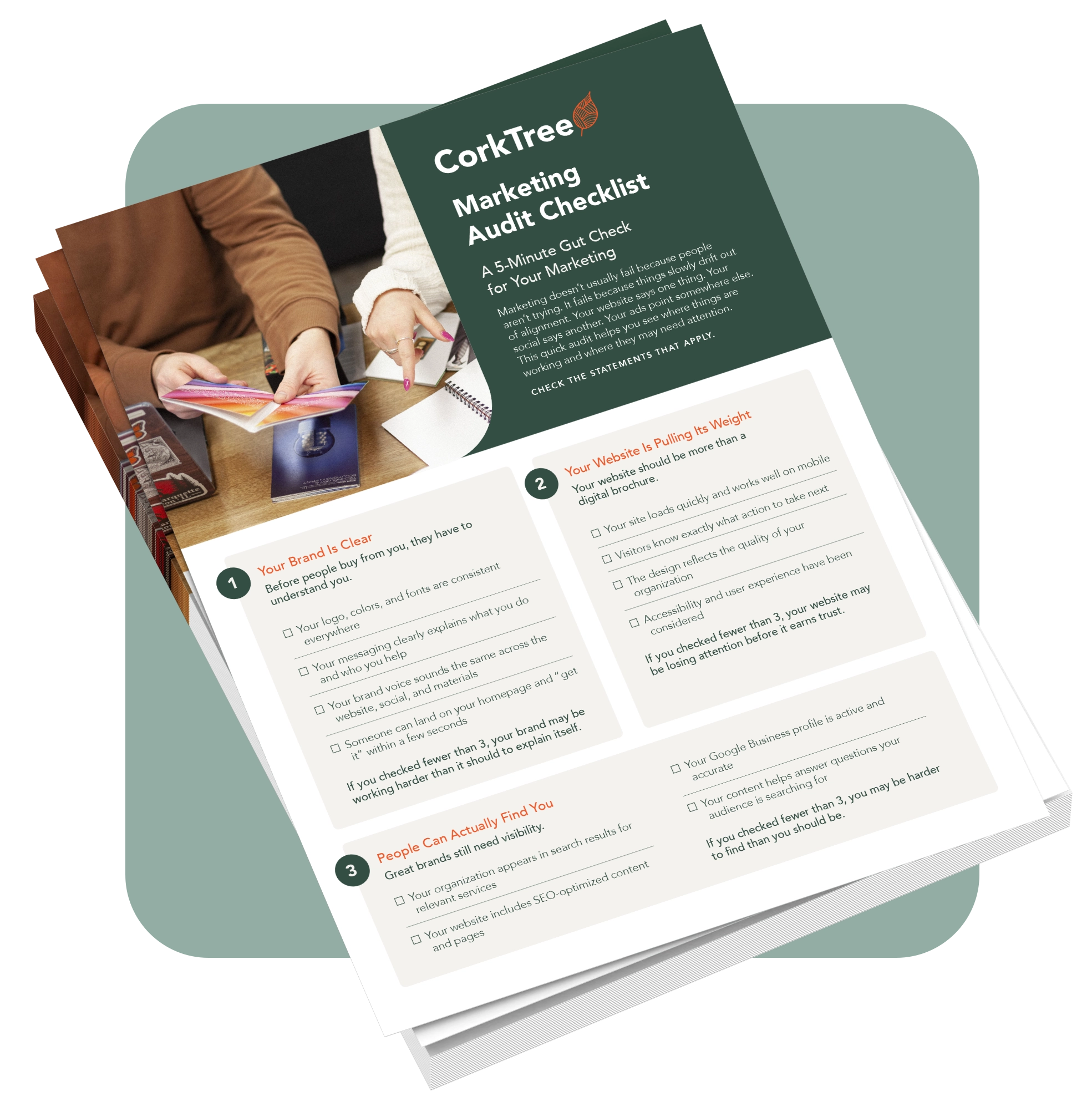
Not sure if your marketing is working the way it should? Our free marketing audit checklist gives you a quick, honest look at what’s aligned and what’s not. Download it and see where you stand.


All Rights Reserved. Design & Development by Cork Tree Creative.